

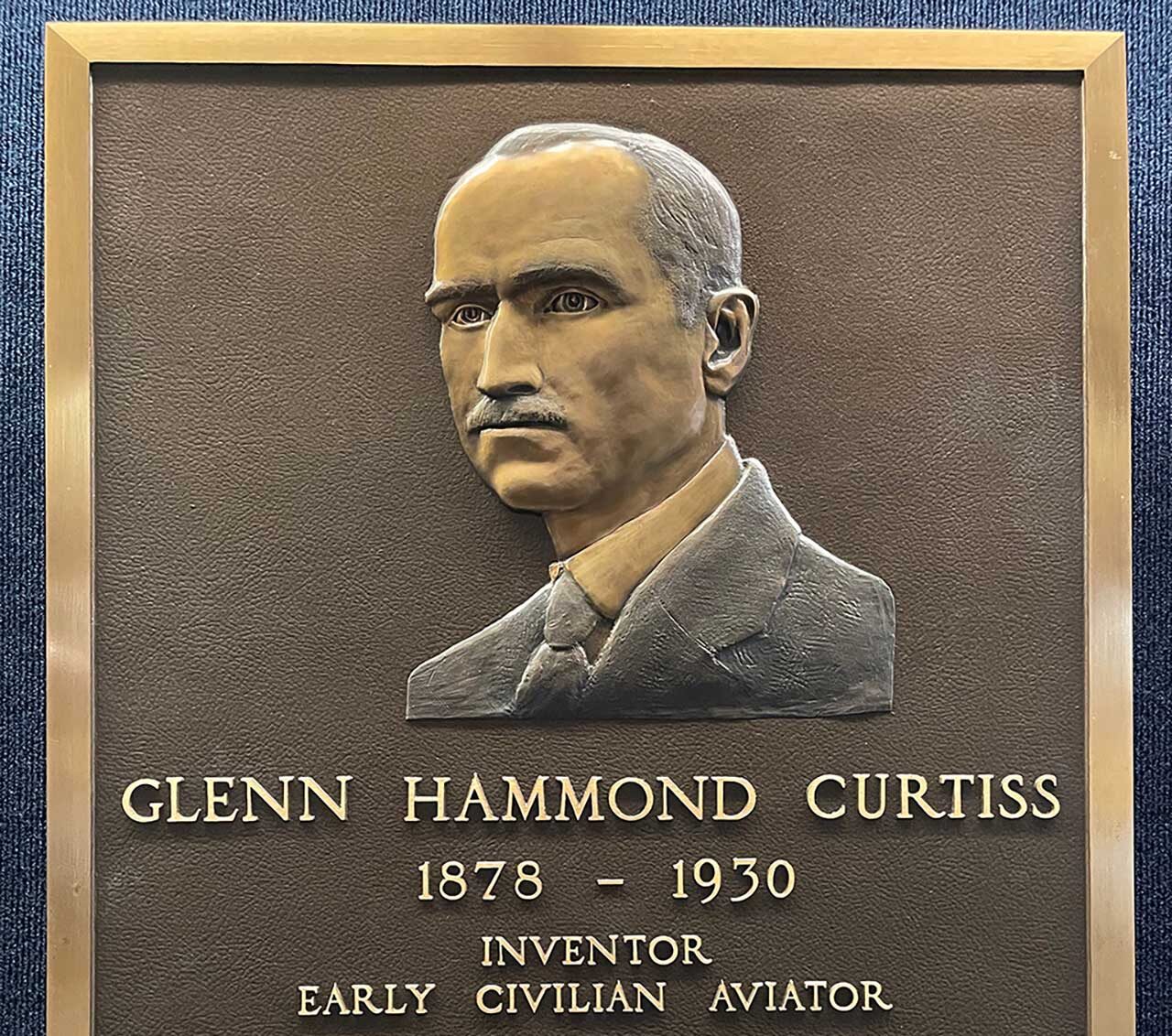
Ever wonder where the fictional character Tom Swift got his name? The character Tom Swift, who first appeared in 1910 in Tom Swift and His Motorcycle and Tom Swift and His Airship, has been said to have been based on Glenn Curtiss. The Tom Swift books are set in a small town on a lake (Lake Keuka, outside of Hammondsport in upstate New York.)
Curtiss has had many accolades which include: National Aviation hall of Fame 1964, International aerospace Hall of Fame 1965, Motorsports Hall of Fame America 1990, Motorcycle Hall of Fame 1998, National Inventors Hall of fame 2003.
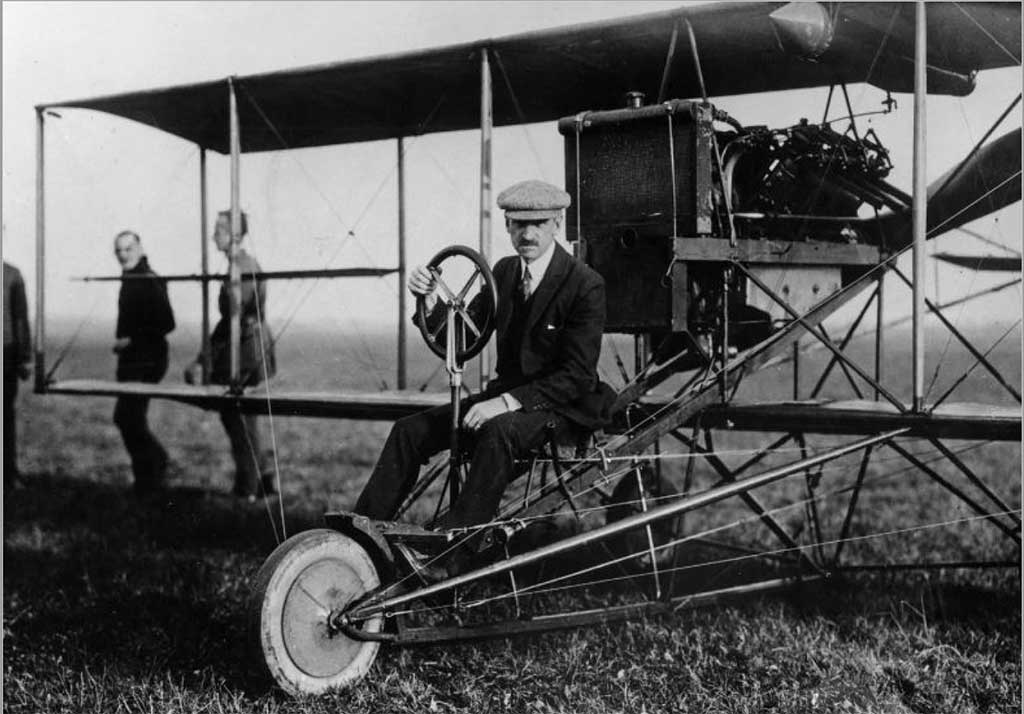
Did you think the Wright brothers had the first flight in the United States? No, the Curtiss plane June Bug was an American “pioneer era” biplane built by the Aerial Experiment Association in 1908 and flown by Glenn Hammond Curtiss. The aircraft was the first American airplane to fly at least 1 km in front of a crowd, thereby beating the Wright brothers claim of the first flight which they made in secret without the press or public in attendance.


The Aerial Experiment Association was a Canadian-American pioneer aviation research group founded on September 30, 1907, in Baddeck, Nova Scotia, by Alexander Graham Bell and financed by his wife, Mabel. (Was Alexander Graham Bell famous for A, Inventing the drink Brandy Alexander? B, The Graham cracker? C, The telephone. (A handheld device your parents used for communication which was most likely attached to a kitchen wall.
The group’s intention was to build a practical, powered heavier-than-air flying machine and introduced key innovations like wingtip ailerons and tricycle landing gear. They also worked out how your luggage would be put on a plane to Rochester and wind up in Detroit.
On July 4, 1908, Curtiss flew 5,080 ft (1,550 m) in the June Bug to win the Scientific American Trophy and its $2,500 prize. It is considered to be the first pre-announced public flight of a heavier-than-air flying machine in America, which won the Scientific American Trophy, the first aviation prize in the U.S.
The June Bug’s importance to aviation is why it is an integral part of the new Glenn Curtiss statue and June Bug Legacy Memorial on Curtiss Parkway. See the public unveiling at 11AM on August 22nd.
But wait, there’s more!
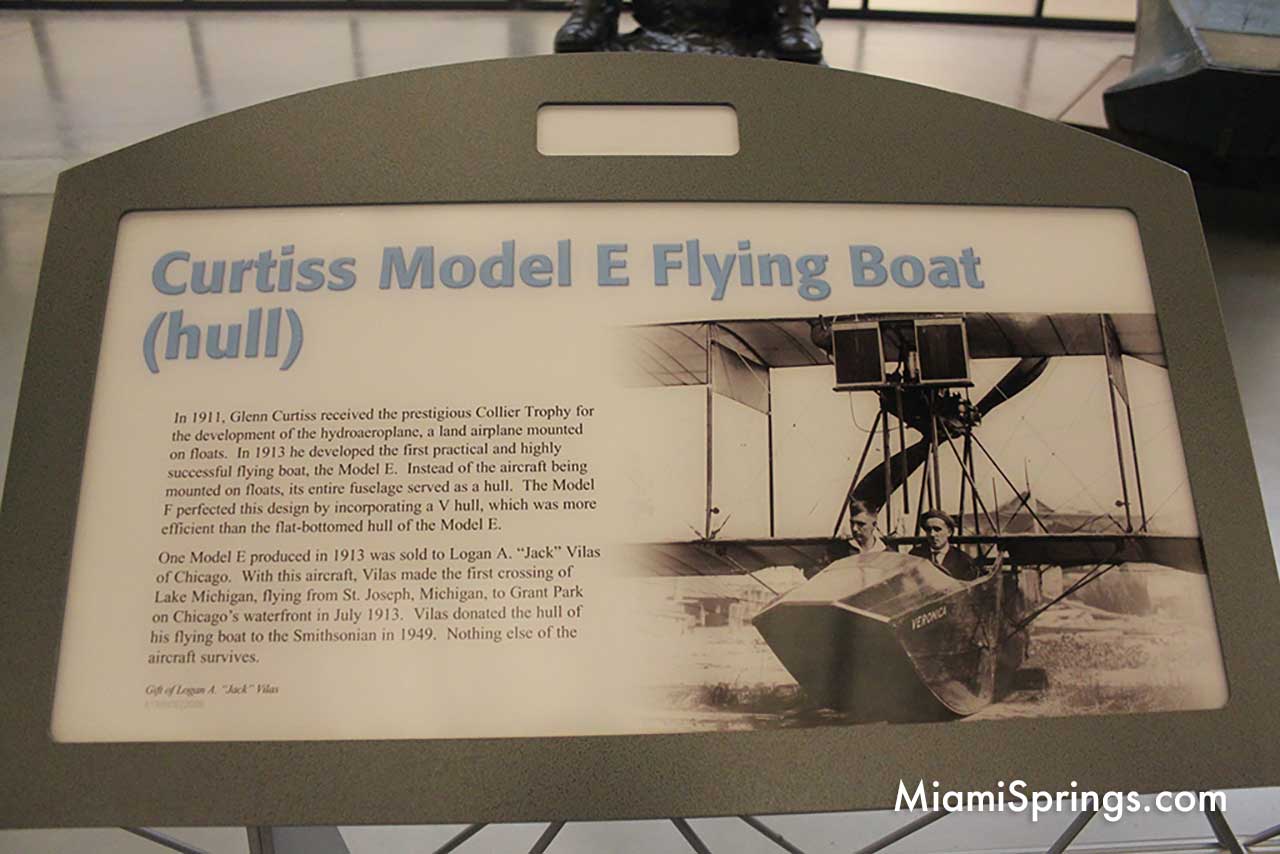
On November 14, 1910, Curtiss demonstration pilot Eugene Ely sat in a Curtiss designed plane positioned on a temporary wooden platform mounted on the forward deck of the cruiser USS Birmingham in San Diego harbor. Up to that point, a plane that could take off from water, which Curtiss pioneered at Lake Keuka near his hometown, had to be hoisted aboard the ship.
Curtiss knew his plane had to make the landing back on that very same ship and hoped the new Curtiss invention of a ‘tail hook’ would not allow it to keep going after it landed and skid off the other end of the ship. It has worked to this very day.
Curtiss had arrived in San Diego after traveling through the Southwest. He admired the local architecture modeled after traditional Native American adobe pueblo homes and Spanish mission buildings. He, along with cattle baron James Bright, expanded their land developments to the south side of the Okeechobee canal which was initially named Country Club Estates. When potable water was discovered under the new golf course, the name was then changed to Miami Springs.
James Bright was the co-developer of Miami Springs. His business interest prior to South Florida had been in the Southwestern states and Mexico. Local homes there included flat roofs, thick stucco walls with rounded corners, and protruding wooden roof beams called vigas. This was to be the theme of their new town.
After moving his family to Florida in the 1920s, Curtiss founded 18 corporations, served on civic commissions, and donated extensive land and water rights. The wellheads on our golf course helped provide water for the growing city of Miami. Still do!
Glenn Curtiss’ frequent hunting trips into the Florida Everglades led to an invention he called the ‘Adams Motor Bungalo’, a forerunner of the modern recreational vehicle trailer (named after his business partner and half-brother, G. Carl Adams).
All these new inventions or improvements to others were a hallmark of the way Curtiss operated. He was a great thinker and tinkerer. As a person whose thoughts were always egalitarian, he was a forerunner in many fields and was revered as a leading force for good in America.
Related articles:
National Naval Aviation Museum Showcases Glenn Curtiss, the Father of Naval Aviation