

The history of South Florida is defined by a single, terrifying inflection point. Before September 18, 1926, the region was an unstoppable real estate juggernaut—the center of the legendary 1920s Florida Land Boom. Ambitious, master-planned cities were rising overnight out of drained Everglades marshlands and coastal pinelands. Investors from across the nation were buying land sight-unseen, fueling an economic expansion of mythic proportions. Then, a Category 4 monster tore through the heart of the region, shattering the boom, leveling entire cities, and forever altering the trajectory of Miami-Dade County.
One hundred years later, we look back at the Great Miami Hurricane of 1926, tracing its meteorological profile and its devastating localized impacts on Greater Miami, Hialeah, and Country Club Estates (which we know today as Miami Springs).
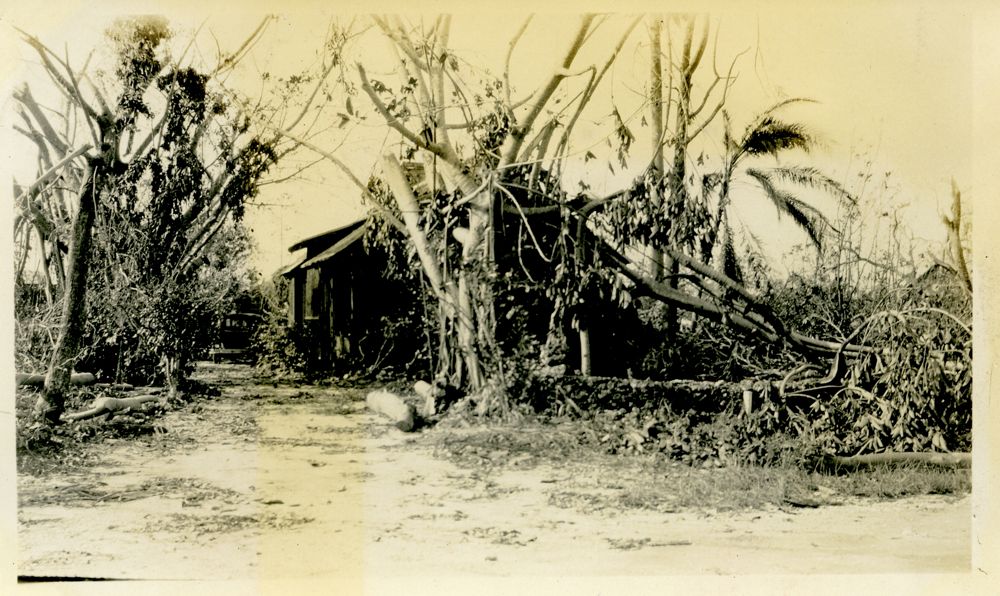
Catastrophic wind damage in Miami on September 18, 1926. Source: Wikimedia Commons / Public Domain

A Cape Verde Monster and the Fateful Eye
The storm was of classic Cape Verde origin, first detected in the central tropical Atlantic on September 11, 1926. In an era preceding weather satellites, reconnaissance aircraft, and sophisticated radar, tracking major tropical systems was an agonizingly primitive science, relying heavily on isolated ship reports. As the hurricane tracked north of the Leeward Islands and Puerto Rico, it remained a dangerous mystery to those in its path.
By the morning of September 17, the storm was barreling directly toward the rapidly expanding metropolis of Greater Miami, where the population had ballooned to over 100,000 residents. Alarmingly, because storm warnings were centralized in Washington, D.C., and distributed slowly, the local Miami Weather Bureau was only authorized to hoist basic storm warnings at noon on September 17. It was not until 11:00 PM that night—as the barometric pressure began a precipitous, terrifying fall—that Official-in-Charge Richard Gray hoisted full hurricane warnings.
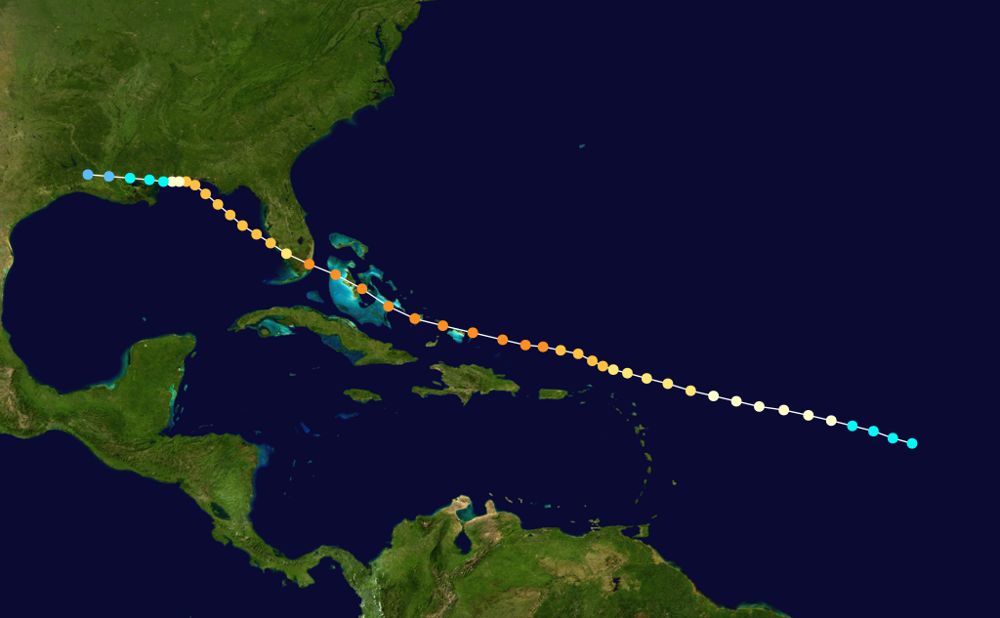
Storm track of the Great Miami Hurricane of 1926, which peaked as a Category 4 major hurricane. Source: Wikimedia Commons / NOAA
The hurricane made landfall in the early morning hours of Saturday, September 18, striking South Florida near Perrine, just 15 miles south of Downtown Miami. Sustained winds were estimated at a screaming 145 to 150 mph (a high-end Category 4 major hurricane), with the lowest barometric pressure dropping to 930 millibars. It was a massive storm, generating hurricane-force winds across a broad swath of the peninsula from the upper Florida Keys to St. Lucie County.
At approximately 6:30 AM, the 30-to-40-mile-wide eye of the hurricane arrived directly over Downtown Miami and Coconut Grove, bringing an abrupt, eerie calm. Unfamiliar with the anatomy of tropical cyclones, thousands of residents mistook the lull for the end of the storm. People emerged into the debris-strewn streets to assess damage, and many who had fled to the mainland began returning across the causeways to Miami Beach.
This proved to be a fatal trap. The lull lasted only about 35 minutes before the backside of the eyewall struck with renewed, terrifying force from the southeast. The sudden return of 150-mph winds drove a massive 10-to-15-foot storm surge from Biscayne Bay directly into the streets of Miami Beach and the mainland, inundating several downtown city blocks. By October 9, the Red Cross reported that the Great Miami Hurricane had claimed at least 372 lives and injured over 6,000 people. In terms of normalized wealth, a similar storm striking today would cause an estimated $235 billion in damage, solidifying its place as the costliest natural disaster in United States history.
The Inland Devastation of Hialeah
While coastal areas bore the brunt of the storm surge, the inland working-class suburb of Hialeah—incorporated just a year earlier in September 1925—experienced extreme structural devastation. spurning any coastal defenses, Hialeah’s flat, low-lying topography and newly constructed wooden-frame houses became an easy target for the Category 4 winds.
The hurricane tore through Hialeah with unimaginable fury, destroying or leaving irreparable structural damage to more than 70% of all homes and buildings. At least 20 to 26 Hialeah residents were killed and over 800 were injured. More than 1,500 local families were left entirely homeless. During the height of the storm, the White House Hotel in Hialeah became a critical bastion of hope and survival, sheltering 293 desperate residents; in a stark testament to the chaos and resilience of that morning, three births and three deaths were officially recorded inside the hotel’s walls.
Hialeah’s nascent entertainment and tourism infrastructure was virtually wiped out:
- Hialeah Race Track (Miami Jockey Club): Having celebrated its grand opening in January 1925, the track’s brand-new, 5,000-seat grandstand had its massive roof completely peeled away and shredded. The accompanying roller coaster and jai alai fronton were entirely destroyed.
- Miami Kennel Club (Hialeah Dog Race Track): The dog track’s extensive kennels were completely flattened by the winds, allowing dozens of racing greyhounds to escape into the raging storm. The destruction was so severe that the facility never reopened.
- Tilford Cinema Studios: The massive film studio and production building was reduced to a giant field of splintered wood and debris, leaving only a single brick wall standing.
Furthermore, because Hialeah was built on drained prairie land, the torrential rainfall combined with the backflow of the Miami River Canal to leave major portions of the city underwater for days, severely hindering rescue and recovery operations.
The Impact on Country Club Estates (Miami Springs)
Just one month prior to the storm, on August 23, 1926, founders Glenn Curtiss and James Bright had officially incorporated their beautiful, planned community under the name Country Club Estates (changed to Miami Springs in 1930). Focused on unique Pueblo Revival architecture and lush greenery, the young community was still in its infancy when the hurricane struck, dealing a severe setback to its development.
The storm uprooted majestic trees across the newly opened Miami-Hialeah Golf Course (which had opened to the public on January 1, 1923) and flattened early Pueblo Revival homes that were still actively under construction. The loss of building materials, equipment, and structural progress was financially devastating to Curtiss and Bright’s development firms, which had invested millions into the city’s early infrastructure.
A notable victim of the storm’s fierce winds was the newly constructed Adams Building located at 201 Westward Drive. Completed in 1925, the Adams Building was a beautiful Spanish-mission style structure housing municipal offices and a fully equipped service station with gas pumps concealed inside Spanish mission towers. The hurricane’s Category 4 winds completely tore off and shredded the building’s iconic front overhang. The structural damage was so severe that the overhang was never replaced. The building eventually served as the Miami Springs City Hall until it was demolished in 1964 to make way for the current municipal building.
In the direct aftermath of the hurricane, the Clune Stadnik Building (then known as the Clune Engineering Building) on the Circle became a vital lifeline for the young community, serving as an emergency hurricane relief station. Despite structural damage, residents gathered there for medical aid, clean water, and shelter. Glenn Curtiss’s personal residence, the Curtiss Mansion (built in 1925 along the golf course), and the grand Hotel Country Club (later known as Fairhavens, built in 1926) survived structurally due to their heavy, solid masonry construction, but both suffered extensive water damage.
The compounding disaster of the 1926 hurricane, followed by a major Everglades flood in 1927 that left Hook Square looking like a lakefront property, severely paralyzed the young community. The economic shock of these events **assuredly sparked** a sudden and total collapse of the 1920s Florida Land Boom, forcing land development companies into bankruptcy and plunging South Florida into an economic depression years before the 1929 stock market crash on Black Tuesday.
A Legacy of Resilience
The Great Miami Hurricane of 1926 remains a stark reminder of the raw power of nature and the vulnerability of unchecked coastal and inland development. Yet, the story of Miami Springs, Hialeah, and Greater Miami in the wake of the storm is ultimately one of resilience. Out of the splintered wood and flooded streets, the early residents chose to rebuild, laying the structural, legal, and community foundations of the modern municipalities we cherish today.