

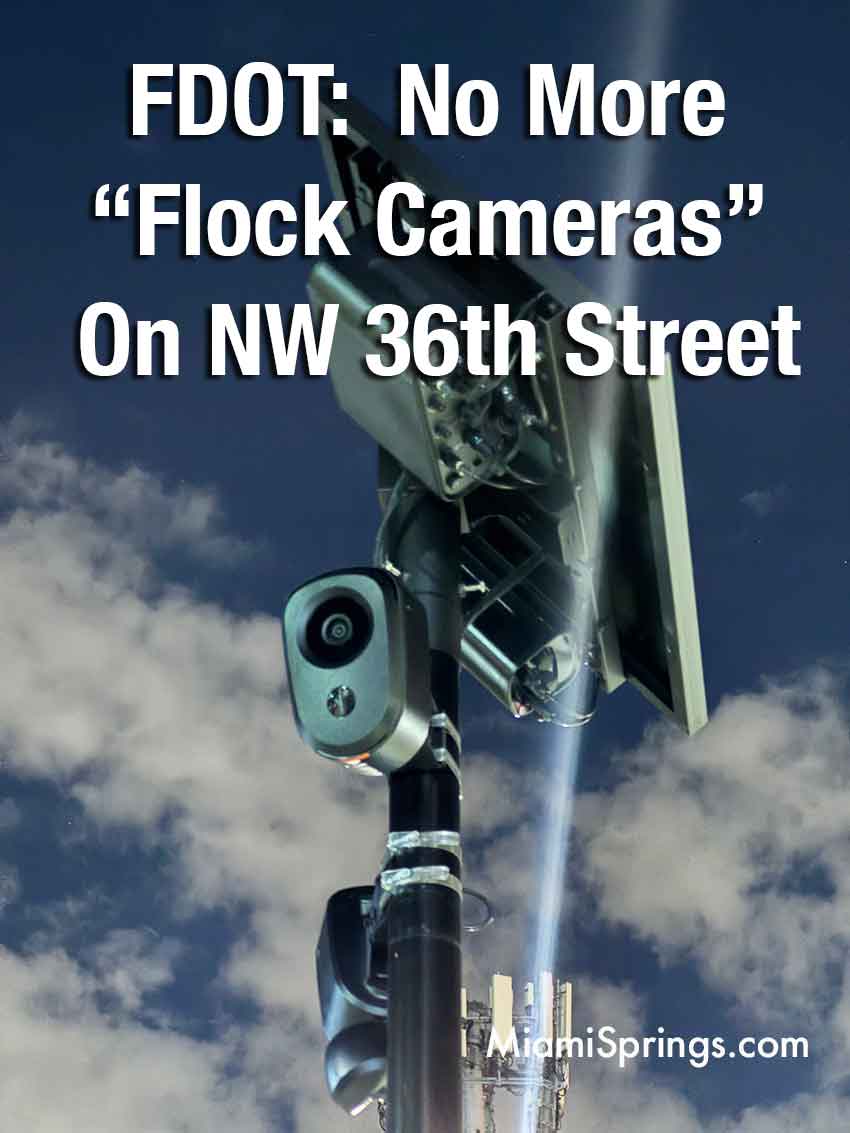
In a major move for data privacy, the Florida Department of Transportation (FDOT) announced today that it is officially revoking all permits for automated license plate readers (ALPRs)—commonly known as “Flock cameras”—on state roads. In Miami Springs, that means all the “Flock cameras” along NW 36th Street aka State Road 948.
Local law enforcement agencies have been given a strict 30-day window to remove the devices from state highway rights-of-way. If any cameras remain after the deadline, FDOT has stated it will remove them itself.
Here is a breakdown of what led to this decision, how local agencies are responding, and what it means for privacy in Florida.

Why FDOT is Pulling the Plug
The use of ALPR technology has exploded in recent years, with cameras constantly photographing, timestamping, and storing the license plates of millions of everyday drivers.
According to the August 31 memorandum issued by FDOT, the state is taking immediate action due to the “exponential increase in deployments along our roadways,” paired with “concerning reports of misuse, data privacy concerns, and surveillance schemes”. The department stressed that this revocation is necessary to preserve “Floridians’ sovereignty and quality of life”.
The pushback against ALPRs has been brewing at the highest levels of state government. Just last week, Governor Ron DeSantis expressed his unease with the technology, stating that while he fully supports law enforcement, he does not want Florida to “become a surveillance state”.
What This Order Doesn’t Cover
While privacy advocates are celebrating the FDOT mandate, they are also pointing out a massive loophole: the order only applies to the state highway system.
State Representative Anna V. Eskamani praised FDOT’s decision as the “right call,” but noted that it remains incomplete. The majority of ALPRs in Florida are installed on local city streets, county roads, and private properties such as homeowner association (HOA) entrances and shopping center parking lots. Because these cameras do not sit on FDOT-controlled rights-of-way, they are completely untouched by today’s memorandum.
Representative Eskamani is now calling on local governments across the state to follow FDOT’s lead, pause new camera contracts, and provide a full public accounting of how data is stored and shared.
As the 30-day countdown begins for cameras on state roads, the debate over privacy versus public safety is likely to shift to city halls and county commission chambers across Florida.
Map of Miami Springs Flock Cameras
Public Safety
Technology is never good or evil. Humans are good and evil. And with every technology that’s ever been invented, we have found uses for good and uses for evil.
In our opinion, the Flock Cameras as deployed and used by the Miami Springs Police Department has been extremely effective at catching criminals. The police will tell you it has helped them apprehend wanted suspects in record time and reduce crime in our community. It has also been a source of revenue that drivers (many of whom don’t live in Miami Springs) pay to support law enforcement, that we the residents don’t have to pay.
We believe completely eliminating Flock Cameras is taking a hatchet to something that needs a scalpel. We believe technology can be used to help identify abuse of a system just as tech is being used to identify criminals.
Final Thoughts?
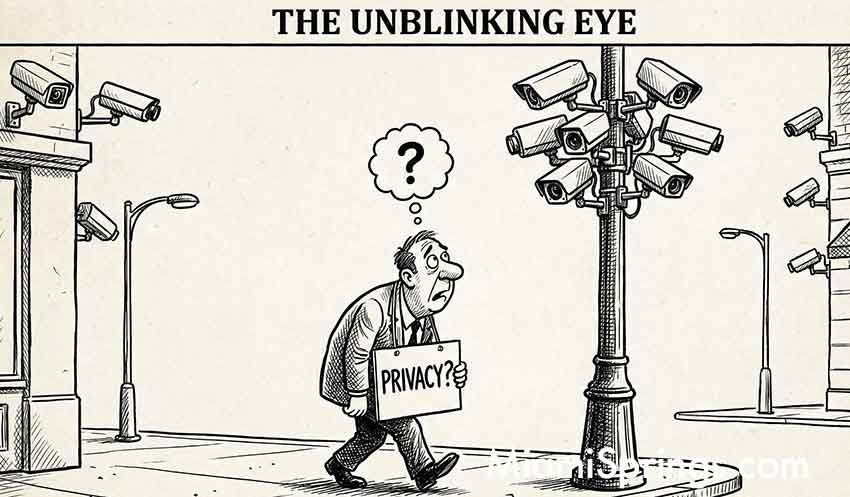
What do you think? Do we want to give criminals a free pass through our busiest thoroughfares? Or is this a much needed push back against big brother?
Share your thoughts in the comments section at the bottom or via social media.