

Today, June 2, 2026, the Florida Legislature officially passed a sweeping property tax reform proposal championed by Governor Ron DeSantis (SJR 2-F / HJR 1F).
If you own a home in Florida, this is one of the most significant pieces of legislation in recent history. It promises massive tax cuts for homeowners, but it also creates a complex ripple effect for local government budgets. Because it’s a constitutional amendment, the final decision will be up to Florida voters on the November 2026 ballot, where it will need 60% approval to become law.
The Homestead Exemption Gets Supercharged
Currently, Florida homeowners receive a $50,000 exemption on their primary residence. This bill drastically increases that amount over a phased period to give local governments time to adjust:

-
2027: The homestead exemption jumps to $150,000.
-
2028: The exemption increases to $250,000.
-
The Future: The bill establishes a framework for future legislatures to completely phase out all non-school property taxes on homesteads.
If your home is assessed at $300,000, for example, you would only pay non-school taxes on $50,000 of its value by 2028.
What Happens to Taxes for Education?
When the idea of eliminating property taxes was first floated, educators were deeply concerned because property taxes are the lifeblood of Florida’s public school system.
Before passing the bill today, the Legislature overhauled the original proposal: public schools are entirely exempt from the cuts. School district levies typically make up about 40% of the average Florida property tax bill. You will still pay the education portion of your property taxes based on your home’s assessed value. This ensures that the multi-billion-dollar tax cut does not drain the state’s education system.
Funding for Police and Schools
Because school taxes were carved out of the exemption, education funding remains securely intact. But what about public safety?
The Squeeze on Small Cities Like Miami Springs
This is where the math gets incredibly tight for local municipalities.
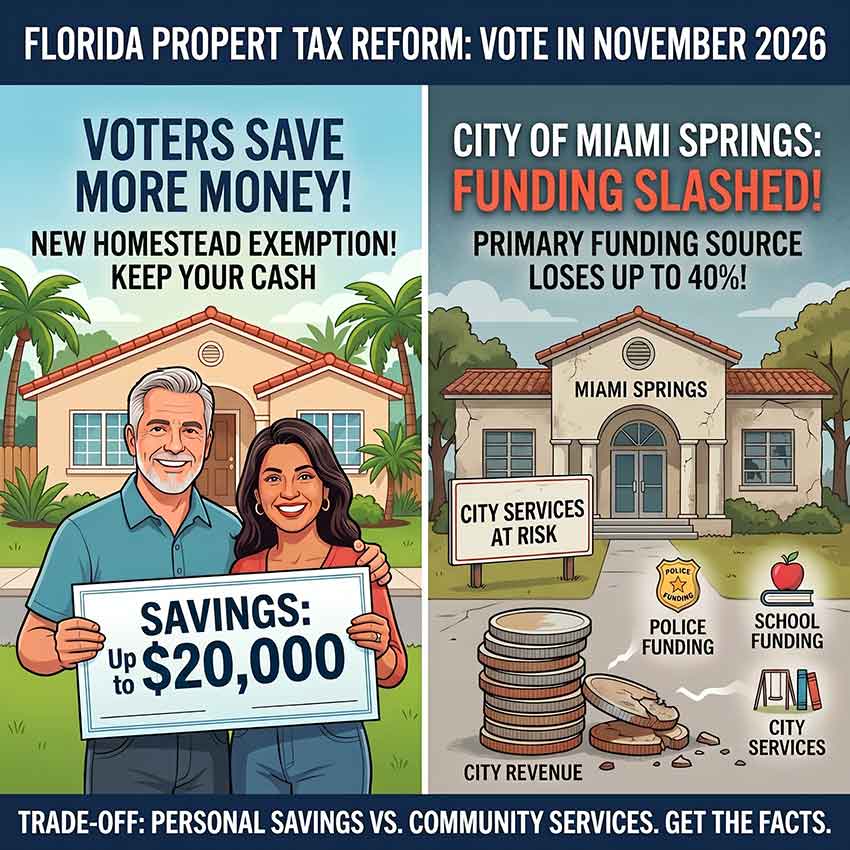
Small cities like Miami Springs rely heavily on property taxes to operate. If the city’s tax revenue is slashed by 20% to 40% because of the new $250,000 exemption, but they are legally prohibited from cutting the police budget, they are caught between a rock and a hard place.
To balance the books, small cities will have to look at the “unprotected” parts of their budgets. For Miami Springs, this will likely mean a combination of two things:
-
Service Cuts: Things like public works, parks and recreation, community centers, street maintenance, and local infrastructure projects could see severe funding reductions.
-
Higher Alternative Fees: To survive the revenue shortfall, local governments may be forced to raise utility taxes, garbage collection fees, stormwater fees, and recreation costs.
Ultimately, the bill presents a major trade-off: Florida home owners will get to keep significantly more of their money, but the shape and scope of local city services may look very different in the years to come.
Your Opinion Matters
Will you vote to repeal the Property Taxes on Homesteaded Properties?
YES
NO