

Property taxes are a perennial hot topic in Florida. For homeowners, they represent a significant annual expense. For local governments, they constitute a primary revenue source essential for funding daily operations.
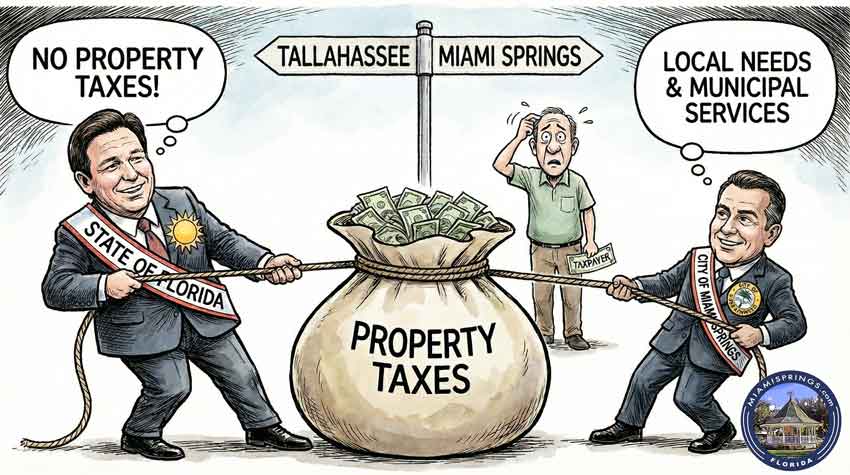
Recently, discussions in Tallahassee have increasingly focused on potential reforms to the state’s property tax structure. While specific legislative proposals shift from session to session, the general trend often leans toward providing further relief to homeowners through mechanisms like increased homestead exemptions, adjustments to assessment caps, or wider systemic changes.
While lowering the tax burden for residents is a popular goal, these proposals inevitably create a complex ripple effect for local governments. For smaller, tight-knit municipalities like Miami Springs, understanding these potential shifts is crucial for both residents and policymakers.

Here is a look at the general nature of these proposals and what they might mean for the local level.
The Basics: How Florida Cities are Funded
To understand the impact of proposed changes, it is necessary to first understand municipal finance in Florida.
A significant portion of a city’s general fund—which pays for police, fire rescue, parks and recreation, public works, and administration—comes from ad valorem property taxes.
The amount a property owner pays is determined by two main factors:
-
Taxable Value: The assessed value of the property minus any exemptions (like the Homestead Exemption).
-
Millage Rate: The tax rate set by various local taxing authorities (the city, the county, the school board, etc.).
When the state legislature passes laws that increase exemptions or cap how much an assessment can grow, it lowers the Taxable Value across the board.
The “Small City” Challenge
When taxable value decreases due to state mandates, cities face a difficult mathematical reality. If the total value of property available to be taxed shrinks, but the cost of providing services (salaries, equipment, fuel, maintenance) continues to rise with inflation, a budget gap is created.
This dynamic impacts all municipalities, but small cities like Miami Springs often face unique challenges compared to larger metropolitan areas.
1. The Reliance on Residential Revenue
Smaller communities (like Miami Springs) often have a higher ratio of residential properties to large commercial or industrial properties. Commercial properties generally do not benefit from the same exemptions (like Homestead exemptions) that residential properties do. Therefore, legislative changes targeted at residential relief disproportionately affect the tax base of residential communities.
2. The Service Balancing Act
In a smaller municipality, budgets are often leaner. There is less “fluff” to cut when revenue dips. If state-level changes significantly reduce projected revenue, local leaders are faced with two primary options, neither of which is politically popular:
-
Raise the Millage Rate: To generate the same amount of money needed to run the city from a smaller pool of taxable value, the tax rate on that remaining value must go up. This can sometimes offset the savings homeowners thought they were getting from the increased exemption.
-
Reduce Services: The alternative to raising rates is cutting costs. In a small city, this could mean adjustments to staffing levels in public safety, reduced hours for parks and recreation centers, or deferred maintenance on roads and infrastructure.
3. Pressure on Non-Homestead Properties
If residential taxes are lowered through exemptions, the burden of funding local government often shifts. To avoid drastically cutting services, municipalities may have to lean harder on revenue from commercial properties, second homes, and rental properties, which do not enjoy the same protections as primary homesteads.
The Miami Springs Context
Miami Springs is valued by its residents for its distinct character, high level of local service, and community feel. Maintaining that quality of life requires consistent funding.
When evaluating proposals from Tallahassee, residents of communities like Miami Springs must weigh the immediate benefit of personal tax relief against the longer-term implications for their local government’s ability to operate effectively.
The debate over property tax reform involves striking a delicate balance. Proponents of higher exemptions argue that rising property values are pricing Floridians out of their homes and that relief is urgently needed. Conversely, local government advocates argue that state mandates erode “home rule,” forcing local communities to make impossible choices between raising tax rates or compromising public safety and quality of life.
Are the Tax Cuts Fair?
What property owner wouldn’t want to have their home free of property taxes? I sure as heck would love not to pay those taxes on my home.
But is it fair?
Here’s what I mean. The tax cut is only for property owners. Generally speaking, property owners, though they may not consider themselves to be rich or wealthy, tend to be better off financially than renters. But renters will be paying property taxes indirectly while property owners do not.
How can that be? Renters don’t pay property taxes.
Yeah. Renters don’t pay a tax bill directly. But renters pay a landlord. And that landlord pays property taxes. Plus the landlord pays for insurance, maintenance, and oftentimes a mortgage. The higher the cost to the landlord, the higher the rent will be.
On the other hand, removing the property taxes would make owning a home more attainable to current renters?
Is there another alternative?
Again. I’m all for less taxes. But I don’t like the idea of burdening renters with a tax that homeowners don’t pay.
Maybe. Just maybe. The right solution is to have a property tax break on homesteaded properties for seniors age 65 and over. They’ve paid their fair share of taxes. Many are on a fixed income. Let’s give the tax break to the elderly.
This also lessens the burden on municipalities like Miami Springs.
What do you think?
Do you like the idea of eliminating property taxes on homesteaded properties for everyone or should it just be limited to seniors?
Let us know what you think in the comments section below or via social media.