

Introduction: The Evolution of a Historic Aviation Enclave
Miami Springs, Florida, stands as a unique municipal entity within the expansive, rapidly densifying landscape of Miami-Dade County. Founded in 1926 by aviation pioneer and real estate developer Glenn H. Curtiss as “Country Club Estates,” the city was originally conceptualized as a master-planned residential enclave characterized by its distinctive Pueblo Revival architecture, a triangular geographic footprint, and its immediate proximity to the burgeoning aviation infrastructure that would eventually become Miami International Airport. A full century after its inception, Miami Springs is navigating the complex intersection of historical preservation, demographic stabilization, and severe regional housing affordability pressures.
As of 2026, the city operates as a vital, high-demand suburban node within the Miami-Fort Lauderdale-West Palm Beach Metropolitan Statistical Area, which houses nearly 6.4 million residents and ranks as the eighth-largest metropolitan statistical area in the United States. While the broader metropolitan region has experienced explosive population growth and widespread vertical densification, Miami Springs has historically utilized its municipal charter to restrict building heights and preserve its low-density, single-family residential character. This resistance to densification has catalyzed a series of profound second- and third-order economic effects. Most notably, these include a rapidly aging housing stock, a slight contraction in total population, an extraordinary escalation in property valuations, and a stark economic polarization between property owners and the local renter class.
This comprehensive research report provides an exhaustive deep dive into the current state of Miami Springs. By analyzing the latest 2024 through 2026 demographic estimates, real estate pricing models, municipal appraiser records, and local policy pipelines, the following analysis presents a nuanced overview of the city’s population dynamics, housing inventory, economic stratification, educational infrastructure, public safety landscape, and future urban development trajectories.

Demographic Architecture and Population Dynamics
Understanding the socioeconomic trajectory of Miami Springs requires a granular examination of its population base, which currently presents a paradoxical trend relative to its geography. While the state of Florida has recently regained its status as the fastest-growing state in the nation—and the broader Miami metropolitan area continues to add population—Miami Springs itself is experiencing a slight demographic contraction.
Population Size, Census Counts, and Historical Trajectory
As of the most recent official estimates extending into 2024 and 2026, the population of Miami Springs is firmly established between 13,726 and 13,901 residents, depending on the specific Census Bureau methodology or American Community Survey (ACS) vintage applied. The city’s population peaked in 2015 at approximately 14,253 residents but has since recorded a steady, albeit marginal, annual decline. Long-term demographic modeling projects a continued slight contraction, with the 2026 population baseline projected to hover near 13,563, representing an annualized change rate of roughly -0.6%.
| Year | Population Estimate | Annual Growth / Decline | Source Indicator |
| 1950 | 5,108 | 0% (Baseline) | Decennial Census |
| 1960 | 11,229 | +119.83% | Decennial Census |
| 1970 | 13,279 | +18.26% | Decennial Census |
| 1980 | 12,350 | -7.00% | Decennial Census |
| 2015 | 14,253 | Peak Population | Census Estimates |
| 2020 | 13,859 | -2.76% (from 2015) | Decennial Census |
| 2024 | 13,726 – 13,901 | -0.6% to -0.7% | ACS / Census Estimates |
| 2026 | 13,563 – 13,958 | Projected Plateau | Demographic Projections |
This localized population decline amidst a booming regional economy points directly to a severely supply-constrained housing market. Because the city has historically prioritized the preservation of low-density zoning, there is limited physical capacity to absorb new residents. Consequently, as average household sizes naturally shrink over time—currently resting at an average of 2.61 persons per household with an average family size of 3.26—the total population naturally declines unless new housing units are introduced to the market.
Age Distribution: The Missing Middle and the Demographic Barbell
The age stratification of Miami Springs reveals a mature community that skews significantly older than the broader metropolitan area. The median age in Miami Springs is 44.2 years, which is notably higher than the Miami-Dade County median of 40.6 years and the Florida state median of 42.6 years.
A detailed segmentation of the population highlights a distinct “barbell” effect, featuring roughly equal cohorts of dependent youth and retirees, supported by a constrained core working class. Analyzing the exact population counts provides a clear view of this dynamic:
-
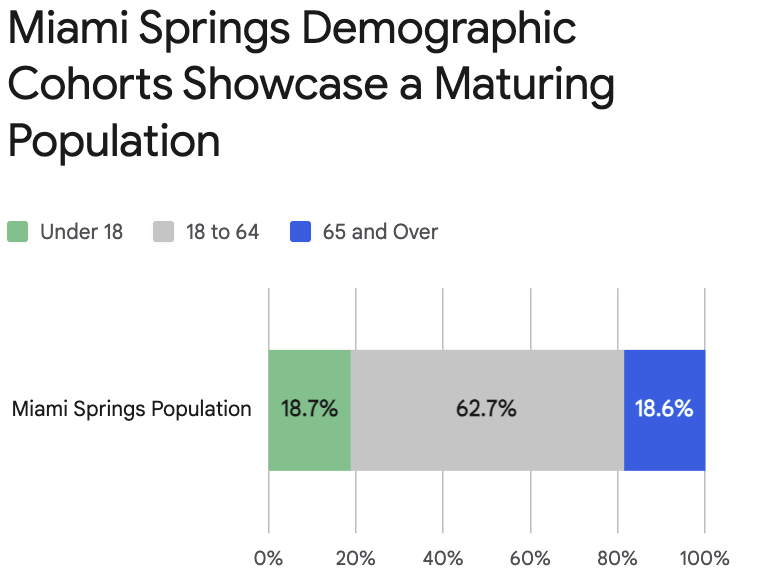
Children and Youth (Under 18): Children under the age of 18 account for exactly 18.7% of the total population. In absolute terms, this represents approximately 2,566 minors living in the city. Families with children under 18 constitute 34.7% of all 5,245 to 5,447 households in the municipality.
-
Working-Age Adults (18 to 64): The core economic engine of the city, working-age adults, make up roughly 63% of the population. Out of a total adult population of 11,157 residents, an estimated 8,610 individuals fall into this primary working demographic.
-
Retirees and Seniors (65 and Over): Seniors constitute 18.6% of the population, representing approximately 2,547 individuals who have reached retirement age.
| Age Cohort | Percentage of Total Population | Estimated Population Count |
| 0 – 9 Years | 11.0% | ~1,510 |
| 10 – 19 Years | 10.0% | ~1,372 |
| 20 – 29 Years | 9.0% | ~1,235 |
| 30 – 39 Years | 13.0% | ~1,784 |
| 40 – 49 Years | 16.0% | ~2,196 |
| 50 – 59 Years | 16.0% | ~2,196 |
| 60 – 69 Years | 13.0% | ~1,784 |
| 70 – 79 Years | 6.0% | ~823 |
| 80+ Years | 7.0% | ~960 |
The demographic parity between the youth population (18.7%) and the senior population (18.6%) illustrates a community in a long-term transition. The substantial senior population exerts specific pressures on municipal services. For instance, the city’s Adult Community Center has an immense footprint in local operations, registering over 1,654 seniors, delivering over 71,395 meals to home-bound residents, and serving nearly 48,000 meals on-site annually. Furthermore, the lack of diverse, affordable housing options frequently forces younger, newly formed households (the 20-29 cohort, which represents a mere 9% of the city) to relocate outside the municipal borders, exacerbating the overall aging trend.
Racial and Cultural Composition
Miami Springs closely mirrors the broader multicultural fabric of Miami-Dade County while maintaining its own distinct socioeconomic identity. The Hispanic or Latino population constitutes the vast majority of the city, representing 79.9% of all residents, equivalent to approximately 11,000 individuals. Non-Hispanic White residents account for 17.4% of the population, with African American, Asian, and individuals identifying with two or more races making up the remaining fractional segments.
Linguistically, the community is deeply integrated into the broader South Florida and Latin American economic nexus. Over 66.7% of residents speak Spanish as their first language, while English is the primary mother tongue for 30.6% of the population. Additionally, 43.6% of the city’s residents are foreign-born, while 56.4% were born within the United States. This underscores the area’s ongoing role as a primary destination for upwardly mobile immigrants seeking suburban stability, strong schools, and proximity to major regional employment centers near the international airport.
The Housing Market: Inventory, Typology, and Value Constraints
The real estate market in Miami Springs is wholly defined by the city’s deep-rooted commitment to low-density zoning. This has resulted in an aging but highly coveted inventory of detached single-family homes. The tension between robust regional demand and artificially constrained local supply has driven property valuations well above both state and national averages.
Housing Inventory and Unit Typology
Miami Springs contains a total of approximately 5,648 housing units. Of these, 5,447 units are actively occupied by households, reflecting a tight overall vacancy rate of just 3.6%. This low vacancy rate is indicative of a highly competitive localized market where demand consistently outstrips the available supply of homes.
The architectural and zoning identity of the city is overwhelmingly dominated by the detached single-family home. Detached single-family units account for 63.2% of the total housing landscape, translating to an exact count of 3,568 detached properties. Within this subset, Miami-Dade Property Appraiser records classify roughly 2,982 to 2,991 of these properties specifically under traditional homesteaded residential codes, indicating that the remaining few hundred detached homes are likely utilized as long-term rental properties, investment assets, or non-homesteaded secondary residences.
Multi-family housing makes up the remainder of the inventory, distributed primarily along the city’s commercial perimeters and arterial roads (such as the NW 36th Street corridor). The strict municipal charter, which limits residential buildings of more than two units to three stories and a maximum height of 40 feet, has effectively halted the development of modern, high-density residential towers found elsewhere in South Florida.
| Housing Structure Type | Percentage of Total Units | Estimated Unit Count |
| 1-Unit, Detached (Single-Family) | 63.2% | 3,568 |
| 20 to 49 Units (Mid-size Multi-family) | 13.7% | 775 |
| 10 to 19 Units (Multiplex) | 8.2% | 464 |
| 3 or 4 Units (Quadplex/Triplex) | 4.6% | 262 |
| 5 to 9 Units (Small Multi-family) | 4.2% | 235 |
| 1-Unit, Attached (Townhouse/Duplex) | 1.9% | 107 |
| 50 or more Units (Large Multi-family) | 1.8% | 104 |
| Mobile Homes / Other | 1.0% | 59 |
The Implications of an Aging Housing Stock
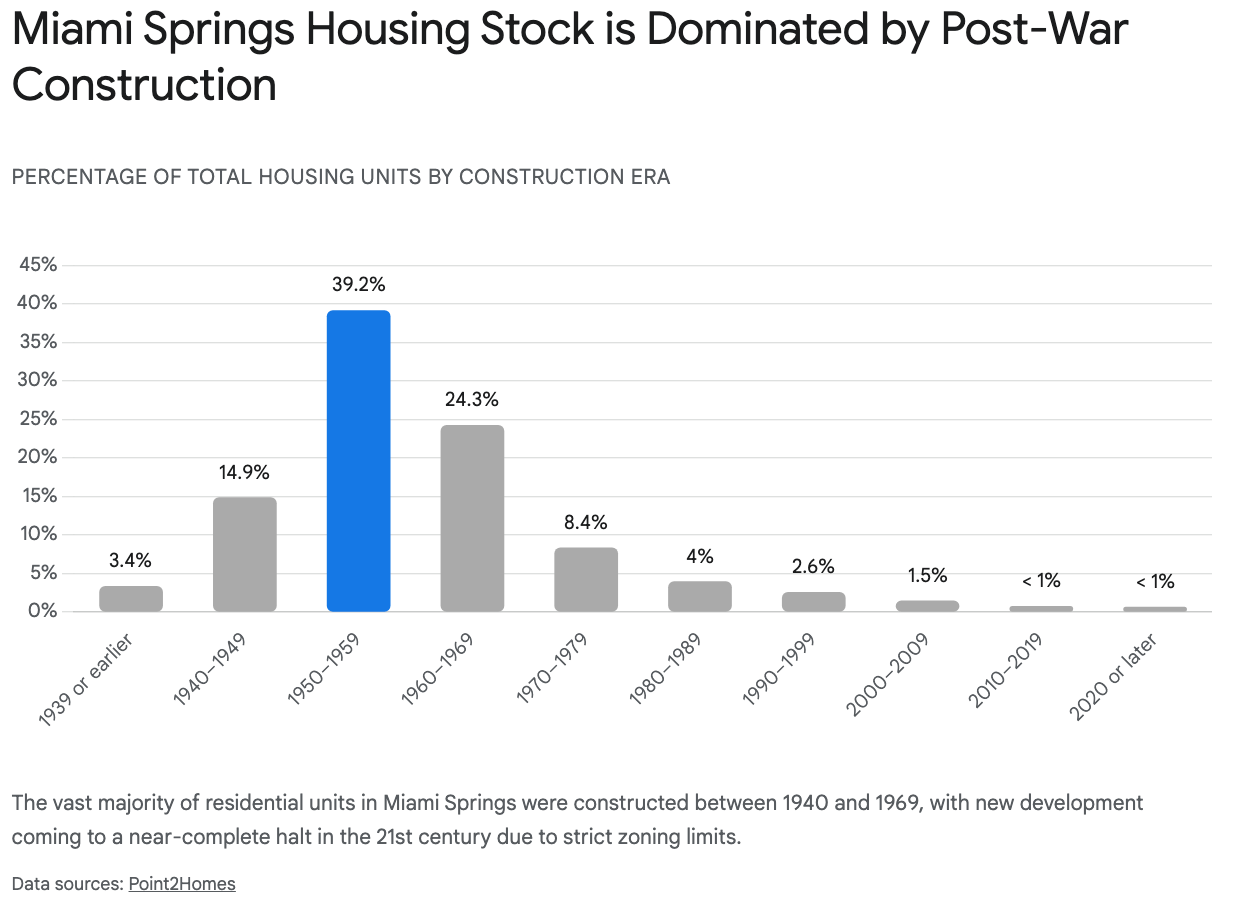
One of the most critical structural challenges facing the Miami Springs real estate market is the extreme age of its physical housing stock. The median construction year for a home in the city is 1958. The historical post-war development boom is strikingly evident in the construction data, revealing that the vast majority of the city was built out prior to the 1970s.
| Era of Construction | Percentage of Housing Inventory | Estimated Unit Count |
| Built 1939 or earlier | 3.4% | 192 |
| Built 1940–1949 | 14.9% | 843 |
| Built 1950–1959 | 39.2% | 2,217 |
| Built 1960–1969 | 24.3% | 1,374 |
| Built 1970–1979 | 8.4% | 475 |
| Built 1980–1989 | 4.0% | 229 |
| Built 1990–1999 | 2.6% | 146 |
| Built 2000–2009 | 1.5% | 87 |
| Built 2010–2019 | 0.8% | 45 |
| Built 2020 or later | 0.7% | 40 |
Only 0.7% of the city’s housing inventory (approximately 40 units) has been built since 2020, and less than 6% of the city has been constructed since the 1990s. This profound lack of new construction carries severe macroeconomic ramifications for residents. Homes built prior to the stringent post-Hurricane Andrew building codes of the 1990s require significant, ongoing capital expenditures for structural maintenance, electrical retrofitting, and mandatory roof replacements. Furthermore, an aging inventory lacking modern wind-mitigation technology places immense upward pressure on homeowners’ insurance premiums, which are already highly volatile and punitive in the coastal South Florida market.
Real Estate Valuations and the Transaction Market
The near-total lack of new inventory, combined with the city’s highly desirable location, excellent schools, and suburban tranquility, has pushed home prices to historic highs. According to long-term ACS Census Bureau estimates, the median value of an owner-occupied home in Miami Springs is $560,800, which is roughly 1.69 times higher than the national average ($332,700) and substantially higher than the Florida state median of $359,000.
However, census estimates often lag behind real-time market dynamics. Live market data from the first quarter of 2026 paints a far more aggressive pricing environment. Current valuations for a detached single-family home in Miami Springs average an astonishing $729,504 according to Zillow’s home value index. Concurrently, Redfin data reports a median sale price ranging from $740,000 to $776,000 depending on the specific closing month.
While the broader 2025–2026 period showed slight cooling in some real estate indices—with year-over-year pricing experiencing mild contractions of 2.4% to 8.8% in median sale prices—the overall cost of acquisition remains exceptionally high. On average, homes in Miami Springs sell after 86 days on the market, at approximately $462 per square foot.
This creates a severe affordability gap for potential buyers. The typical home price in Miami Springs demands an income significantly higher than the local median to avoid being cost-burdened. Advanced community modeling indicates that while the median household income is relatively strong, there remains a substantial structural gap—estimated at over $73,225 annually—between current resident earnings and the actual income genuinely required to safely finance a $700,000-plus single-family home at current 30-year fixed mortgage rates (averaging 6.10%) while factoring in soaring average annual homeowner’s insurance premiums (estimated at $5,386 locally) and effective property tax rates (1.02%).
Economic Vitality: Income, Employment, and the Wealth Divide
The economic profile of Miami Springs is defined by a comfortable overarching median income that entirely masks a deep, structural stratification between property owners and the renter class.
Household Income and Wealth Distribution
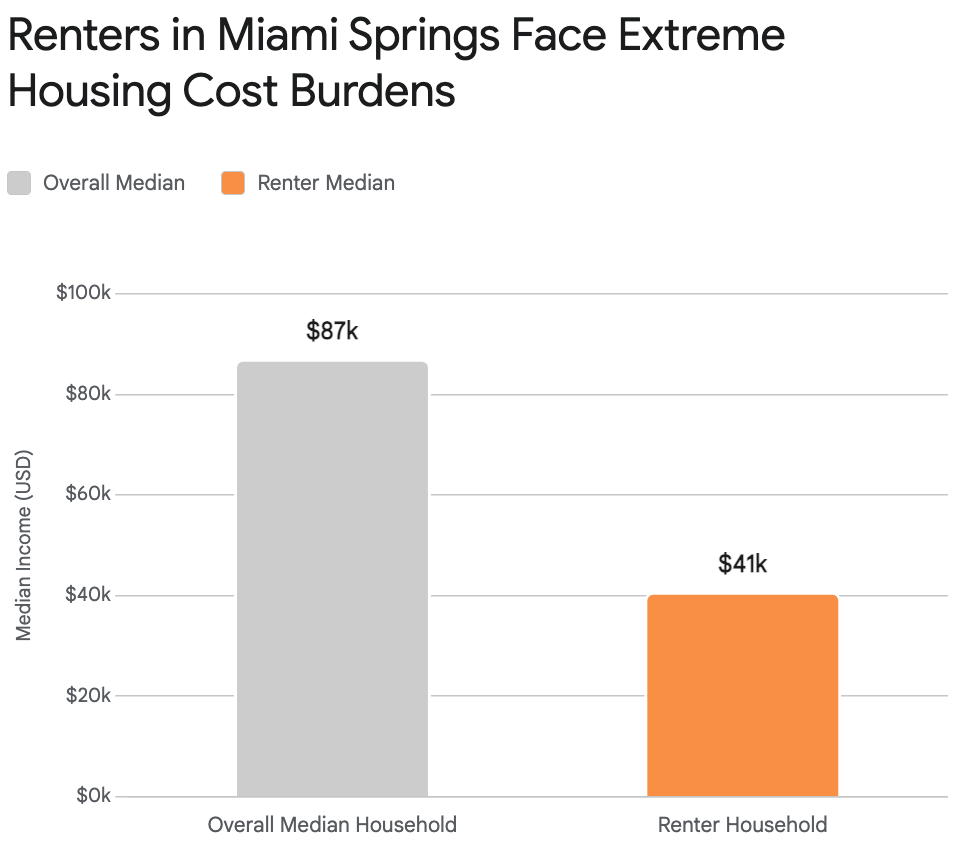
The overall median household income in Miami Springs is $87,099. This figure places the city comfortably above both the Miami-Dade County median ($76,184) and the Florida state median ($77,735). The average (mean) household income is substantially higher at $126,629, indicating a heavy concentration of high-earning households pulling the overall average upward. Indeed, the largest single share of households in the city belongs to the $200,000+ top-tier income bracket, representing 19% of all households.
When analyzing income by specific age brackets, peak earning years align with established families:
-
Households led by residents aged 25 to 44 earn a median income of $115,672.
-
Households led by those aged 45 to 64 earn a median of $105,326.
-
Households led by residents over 65 see their incomes drop to a median of $43,657 as they enter fixed-income retirement.
However, the economic reality is not uniformly affluent. Approximately 10.1% of the population (representing 1,346 residents) lives below the federal poverty line. Poverty disproportionately affects the vulnerable ends of the age spectrum, encompassing 8.7% of children under 18 and 4.9% of seniors aged 65 and over.
The Renter vs. Owner Economic Divide
The most glaring economic disparity in Miami Springs lies along the fault line of housing tenure. The city exhibits a healthy homeownership rate, with 61.1% of households (3,328 units) owning their homes, while renters occupy the remaining 38.9% of housing units (2,119 units). Among those who own their homes, 62.2% carry a mortgage.
The financial profile of these two groups is drastically different:
-
Homeowners: While specific municipal-level median income data isolated solely for homeowners in Miami Springs is grouped within broader census metrics, regional data acts as a highly reliable proxy. In Miami-Dade County, the median income for homeowners is $100,721. Given that Miami Springs’ overall median income ($87,099) outpaces the county average by over $10,000, the local homeowner median is logically situated well above the $100,000 threshold, likely mirroring the $115,672 median seen in the prime working-age demographic.
-
Renters: Conversely, the median household income for renters in Miami Springs is a mere $40,769.
This $46,000-plus chasm between the overall median income and the specific renter median income highlights a growing working-class crisis within the city. Renters in Miami Springs are facing extreme financial pressure, dedicating an astonishing average of 42.4% of their gross earnings directly to housing expenses. Any rent-to-income ratio exceeding 30% is generally classified by the Department of Housing and Urban Development (HUD) as “cost-burdened.” At 42.4%, the average Miami Springs renter falls deeply into the “severely cost-burdened” category, leaving little disposable income for transportation, healthcare, or savings.
The Rental Market Landscape
This high rent burden is a direct consequence of escalating lease rates across all asset classes in the area. The rental market provides a mix of traditional apartments and leased single-family homes, with overall base rents heavily dictated by the city’s extreme proximity to major employment hubs at Miami International Airport.
As of early 2026, the average rent for an apartment in Miami Springs sits at $1,824 per month, yielding an average footprint of just 743 square feet. The base apartment costs break down across unit sizes as follows:
-
1-Bedroom: $1,584 to $1,800 per month (averaging 645 sq. ft.).
-
2-Bedroom: $1,974 to $2,500 per month (averaging 821 sq. ft.).
-
3-Bedroom: $3,657 to $3,797 per month (averaging 1,230 sq. ft.).
When factoring in all available rental properties on the market—including the highly desirable leasing of detached single-family homes and townhouses—the blended median rent leaps dramatically to between $3,375 and $3,550 per month. Single-family houses for rent command absolute premium prices, averaging $3,800 monthly, making them wholly inaccessible to the typical $40,000-earning renter demographic in the city.
Workforce, Commuting, and Major Employers
Miami Springs boasts a robust, active labor force of 7,393 working adults, drawn from the broader pool of 8,610 working-age residents. The city’s economy is inextricably linked to the surrounding logistics, municipal, and aviation infrastructure. The top-paying local industries for residents include Public Administration (averaging $120,226 annually), Utilities ($96,600), and Health Care & Social Assistance ($78,194). There is a notable gender wage gap within the city, with males realizing a median income of $50,399 compared to $36,190 for females, reflecting broader regional discrepancies in industry concentration.
Major local employers situated within or immediately adjacent to Miami Springs reflect the area’s service, aviation, and municipal focus. Key corporate entities operating locally include FEAM Aero (a major aviation maintenance and engineering firm), Lime Company, Miami and Miami Realtors, and the City of Miami Springs municipal government. Regionally, the Miami-Dade County economy is anchored by massive healthcare, retail, and aviation systems that employ thousands of Miami Springs residents. The principal employers for the broader county include Miami-Dade County Public Schools, Miami-Dade County Government, the U.S. Federal Government, the State of Florida, Publix Super Markets (employing over 14,000 locally), American Airlines, Baptist Health South Florida, and the University of Miami.
Commuting patterns further illustrate the city’s integration into the broader sprawling metropolis. The average travel time to work for a Miami Springs resident is 28.2 minutes, which is slightly higher than the national average of 26.4 minutes. A dominant 63.8% of the workforce commutes by driving alone, highlighting a systemic reliance on personal vehicles despite the theoretical presence of regional public transit options. Interestingly, a significant 20.2% of the workforce now operates from home, a structural shift stemming from post-2020 labor dynamics that has permanently altered daytime population density, traffic patterns, and local daytime retail demands within the city. Approximately 2.68% of the workforce endures a “super commute” exceeding 90 minutes each way.
Educational Attainment and Institutional Infrastructure
The economic resilience and high property values of Miami Springs are fundamentally underpinned by a highly educated populace and a strong network of localized public schools.
Adult educational attainment in the city is exceptionally high relative to the broader region. Approximately 40.8% of Miami Springs residents aged 25 and older hold a Bachelor’s degree or higher. This is notably superior to the Miami-Dade County average of 34.4% and the Florida state average of 34.2%. Furthermore, 87.2% of the city’s population possesses at least a high school diploma, ensuring a highly literate and capable baseline workforce. Digital literacy and access are nearly universal, with 97.2% of households owning a computer and 91.8% maintaining a broadband internet subscription.
The public education system serving the city is well-regarded, adding a distinct premium to local real estate values for young families. Elementary education is anchored by Springview Elementary School. Ranked among the top public elementary schools in Florida, Springview boasts an “A-minus” institution grade by Niche and serves approximately 313 students with a 17-to-1 student-teacher ratio. Springview offers a holistic, high-level curriculum including Cambridge International coursework, Gifted & Talented programs, and ESOL support, resulting in exceptional standardized testing proficiency scores of 87% in mathematics and 82% in reading.
Other highly rated institutions operating in the immediate vicinity include ISAAC (Integrated Science And Asian Culture Academy K-8), the AIE Charter School, and Miami Springs Elementary School—all of which have historically held prestigious “A” grades from the Florida Department of Education. Secondary education is provided locally by Miami Springs Senior High School, which maintains a solid “B” rating, though a segment of the population utilizes the county’s extensive magnet school network or private alternatives for advanced secondary education.
Public Safety and Crime Dynamics
Crime and public safety are paramount metrics for any suburban municipality, particularly one situated in the center of a dense urban county. In the context of the wider Miami metropolitan area—which has historically grappled with fluctuating crime rates—Miami Springs maintains a localized profile that requires nuanced statistical interpretation.
While the broader Miami-Dade County region saw a commendable decrease in total Part 1 crimes (encompassing both violent and non-violent offenses) of roughly 13.6% in the early months of 2024 compared to the previous year, neighborhood-level analytics suggest Miami Springs experiences unique pressures due to its commercial corridors and immediate proximity to major highways. Independent data modeling indicates that the overall crime rate in Miami Springs sits at roughly 25 crimes per 1,000 residents. This places the statistical likelihood of becoming a victim of either a violent or property crime at 1 in 41 within the city limits.
However, it is vital to differentiate between violent and property crimes to understand the true threat landscape. Florida’s statewide violent crime rate has trended downward in recent years, settling at roughly 267 incidents per 100,000 people in 2024, with property crime significantly higher at 1,420 per 100,000. The statistical vulnerability in Miami Springs leans heavily toward property crimes—such as commercial larceny, retail shoplifting, and motor vehicle theft. These types of property offenses are highly common in communities that border high-traffic commercial zones, airport logistics hubs, and major transit arteries, drawing transient crime that inflates local per-capita statistics without necessarily reflecting danger within the deep residential neighborhoods.
Municipal Finance and Infrastructure Operations
The financial health of the municipal government dictates the quality of life, infrastructure maintenance, and tax burden placed upon the residents of Miami Springs. Based on the city’s Annual Comprehensive Financial Report (ACFR), the local government operates with a high degree of fiscal conservatism.
The city government employs a substantial workforce to manage its operations, maintaining full-time equivalent employees across various civic functions including robust police services, public works, parks and recreation, and municipal administration. A notable point of fiscal stability is that the city recently reported carrying absolutely no General Obligation (GO) Bonds, indicating a strict aversion to saddling taxpayers with long-term, voter-approved debt for capital projects.
Employee pension liabilities, a common pressure point for Florida municipalities, are actively managed. The city participates in defined benefit plans, and recent state-level reporting indicates that aggregate asset values and employer contributions for local government retirement plans have increased, ensuring that the retirement systems for police and municipal workers remain funded.
However, the primary financial challenge for Miami Springs is revenue generation. Because the city is overwhelmingly residential—with 63.2% of its footprint dedicated to single-family homes—the property tax burden falls disproportionately on individual homeowners rather than commercial enterprises. The median property tax paid by a homeowner in Miami Springs is $3,328 annually, a figure that continues to climb as property values skyrocket. To lower this residential tax burden, the city desperately needs to expand its commercial tax base.
Urban Policy, Zoning, and Future Development Trajectories
As Miami Springs looks toward the end of the 2020s, the city has arrived at a critical inflection point regarding urban development. The structural deficit of new housing, the aging residential infrastructure, and the urgent need to expand the commercial tax base have forced the municipal government to reconsider its century-old zoning philosophies.
The Decades-Long Annexation Battle
For nearly 25 years—representing a quarter of the city’s entire existence—Miami Springs and the neighboring Village of Virginia Gardens have attempted to annex lucrative, unincorporated commercial tracts to their immediate west, stretching toward the Palmetto Expressway (NW 72nd Avenue). This annexation would massively increase the commercial tax base of Miami Springs, allowing the city to simultaneously lower residential property taxes while funding vital infrastructure improvements. However, political friction at the Miami-Dade County Commission level has routinely stalled these efforts, with county commissioners historically voting down the annexation to keep the commercial revenues within the county’s general fund. This persistent denial leaves Miami Springs entirely reliant on its internal borders for revenue generation.
The Pivotal 2026 Height Restriction Referendum
Because external annexation remains politically fraught and largely stalled, Miami Springs is looking inward to spur commercial and residential redevelopment. The focal points of this internal revitalization effort are the NW 36th Street corridor and the “Abraham Tract”—areas situated on the city’s periphery that are uniquely designated for warehousing, logistics, and multi-family development.
The primary obstacle to modernizing these corridors has been the City Charter itself. Currently, the charter strictly dictates that any building containing more than two residential dwelling units shall not exceed three stories and a maximum of 40 feet in height. In the modern construction era, these arbitrary limits render mixed-use and mid-rise residential developments financially unviable for developers. The cost of land acquisition, materials, and labor cannot be recouped on a three-story building, effectively freezing the city’s commercial corridors in time and preventing the construction of the “missing middle” housing required by young professionals and downsizing seniors.
To address this systemic bottleneck, the Miami Springs City Council has prepared a critical referendum scheduled for the August 2026 general primary election. The ballot measure asks voters to officially remove the residential height and story restrictions in the NW 36th Street and Abraham Tract zoning districts east of East Drive.
If passed, this referendum will fundamentally alter the developmental trajectory of Miami Springs. It will unlock a dormant “industrial pipeline” and invite high-density residential and mixed-use developers to build upward along the city’s southern commercial border. Proponents argue this is an absolute necessity; it will alleviate localized housing shortages, introduce vital new commercial property tax revenues to subsidize homeowners, and secure developer commitments for “Public Benefit” infrastructure programs. Detractors, however, fear that piercing the historic 40-foot height limit will shatter the suburban, small-town Pueblo Revival identity established by Glenn Curtiss a century ago, bringing unwanted traffic and density to the quiet enclave.
Conclusion
Miami Springs in 2026 is a community defined by its stark internal contrasts and external geographic pressures. It boasts a highly educated, affluent homeowning class living in a meticulously preserved historic environment, yet it rests atop a struggling, financially distressed renter population burdened by housing costs that consume over 40% of their income. The city’s median home values, soaring past $700,000 on the open market, reflect an intense, unyielding demand for suburban tranquility in South Florida. However, the almost total lack of new construction since the 1970s threatens the long-term sustainability of the community’s infrastructure, driving up insurance costs and shutting out the next generation of homebuyers.
Moving forward, the city’s economic and civic health relies entirely on the delicate balancing of historical preservation and necessary urban progress. The outcome of the August 2026 zoning referendum will serve as a definitive bellwether for the city’s future. Should residents vote to ease height restrictions along the NW 36th Street commercial corridor, Miami Springs will enter a new era of localized, controlled densification—securing its commercial viability while attempting to ring-fence and protect its historic residential core. Regardless of the electoral outcome, Miami Springs remains one of Miami-Dade County’s most resilient and distinctive enclaves—a century-old aviation town navigating the complex realities of a 21st-century metropolis.