

The Miami Springs City Council made the wise move to push back a ballot question on zoning from an April special election to the August general primary election. This does a couple of things:
- It saves the city thousands of dollars by not having to pay for a special election.
- It provides residents ample time to debate / provide feedback on the referendum.
What’s going to be on the ballot?
Well, we still don’t know. But here are the first sample questions provided by the Miami Springs City Attorney in preparation for Monday’s special Council Meeting:
Ballot Language – Option 1
Removing Residential hieght and Story Restrictions in Northwest 36 Street and Abraham Tract Zoning Districts
The City Charter provides that any building that includes more than 2 residential dwelling units shall not exceed 3 stories and a maximum of 40 feet in height.
It is proposed to remove the height and story limits from building with residential units east of East Drive in the NW 36th Street and Abraham Tract zoning districts, which districts may be amended by ordinance.
Shall the above-described amendement be adopted?
YES
NO
Ballot Language – Option 2
Removing Residential hieght and Story Restrictions in Northwest 36 Street and Abraham Tract Zoning Districts
The City Charter provides that any building that includes more than 2 residential dwelling units shall not exceed 3 stories and a maximum of 40 feet in height.
It is proposed to remove the height and story limits from building with residential units east of East Drive in the NW 36th Street and Abraham Tract zoning districts, which districts may be amended by ordinance.
Shall the above-described amendement be adopted?
YES
NO
Neither ballot language was adopted at Monday’s Miami Springs City Council Meeting. However, this gives you, the resident voter, the ability to start debating the pros and cons of these proposals.

What would these measures do?
Both proposals encourage denser residential development.
Removes all residential height restrictions within the districts.
Removes all story restrictions within the districts.
Basically, you can build residential towers as high as you want within these districts.
Pros:
1. Economic Feasibility & Modernization
-
The “3-Story” Problem: Modern construction costs are high. Developers often argue that building only 3 stories is “economically unfeasible” because they cannot sell enough units to cover the cost of the land and construction. Allowing more height makes it profitable for developers to buy and demolish the old buildings.
-
Highest and Best Use: The current 36th Street corridor is underutilized relative to its location (next to a major international airport). Zoning changes allow the land to generate significantly more value.
2. Improved “Curb Appeal” & Pedestrian Experience
-
Gateway Aesthetics: NW 36th Street is often the first thing visitors see when entering Miami Springs. Replacing aging motels with modern mixed-use buildings (shops on bottom, apartments on top) could improve the city’s image.
-
Sidewalk Widening: New developments often come with requirements to build wider sidewalks, plant trees, and install better lighting, making the area walkable and safer for pedestrians—something the current corridor lacks.
3. Safety & Crime Reduction (CPTED)
-
Eliminating Blight: “Crime Prevention Through Environmental Design” (CPTED) suggests that replacing transient, cash-based motels with permanent resident housing reduces illicit activities (drug trade/prostitution) often associated with short-term lodging.
-
Passive Surveillance: Having permanent residents “eyes on the street” (people walking dogs, looking out windows) acts as a deterrent to crime compared to empty industrial lots or transient areas.
4. Housing Supply
-
Regional Demand: Miami-Dade is in a housing shortage. Adding density here provides housing inventory.
Cons:
- More density. More people.
- Say goodbye to the small town feel. It’s hard to stay a small town when we add thousands of new residents to Miami Springs.
- More people in our community means more people on our roads, parks, schools, etcetera.
- Diluted Voted
- Increasing the number of voters in Miami Springs can dilute the vote, especially from long term residents.
- Infrastructure Strain (Beyond just “Traffic”)
- Utilities: Can the current sewer, water pressure, and electrical grid in that district handle hundreds of new toilets, showers, and air conditioners? Upgrading this infrastructure is expensive and disruptive.
- Emergency Services: Does the Miami Springs Police/Fire Department have the equipment (e.g., tall enough ladder trucks) and staffing to handle 6-to-10-story buildings? High-density fires or medical emergencies require different resources than single-family homes.
- The “Canyon Effect” & Shadowing
- Loss of Light: Taller buildings cast longer shadows. Depending on the orientation, new towers could block sunlight for adjacent properties, the golf course, or lower-density homes behind the commercial strip.
- Wind Tunneling: Rows of taller buildings can create wind tunnels that make walking at street level unpleasant.
- Parking & Traffic Specifics
- The “Spillover” Risk: If the new developments are granted “parking variances” (allowed to build fewer spots than residents need), those cars don’t disappear—they park in nearby residential neighborhoods or clog commercial lots.
- Corridor Paralysis: NW 36th Street is a state road and a major airport artery. Adding hundreds of residential cars entering/exiting during rush hour could turn a busy road into a parking lot, affecting emergency response times.
- Construction Nuisance
- Long-term Disruption: Building a “massive residential tower” takes 18–36 months. This means years of pile driving (noise), dust coating nearby homes/cars, and lane closures on 36th Street.
- Precedent & Spot Zoning
- The “Slippery Slope”: If height limits are removed here, it sets a legal precedent. Developers in other parts of Miami Springs (like the downtown Circle or near the Golf Course) may sue or petition for the same rights, arguing “you let them do it on 36th Street.”
- District Expansion Creep
- Once the height restriction is lifted within a small zone, you no longer need a charter amendment to expand it. You just need three council members to agree to expand the zone and voila, an area never intended for limitless height restrictions can now go beyond three stories.
Where would the height restrictions be lifted?
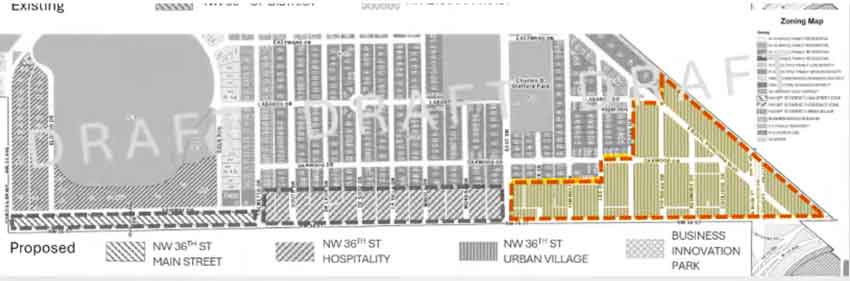
Option 1 – East of East Drive:
This option only allows development East of East Drive. It also is not just NW 36th Street as it removes height restrictions all the way to South Royal Poinciana Boulevard.
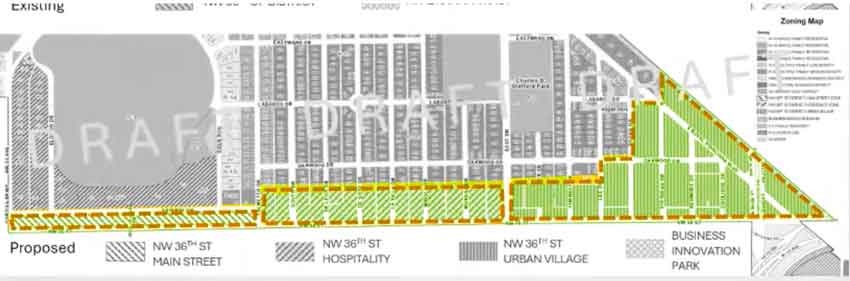
Option 2 – All of NW 36th Street and Much More:
The option would allow limitless heights on any residential development from Curtiss Parkway to Le Jeune Road. Again, this is not just NW 36th Street as it removes height restrictions up to South Royal Poinciana Boulevard.
Eyes Wide Open
Let me be clear.
This is not the official ballot question. The City has not yet selected what the ballot question will be. However, this initial first language give us the opportunity to look at the proposal EYES WIDE OPEN.
What’s the positive? What’s the negative? Is this our best option? Is there a better idea to bring to the table?
It’s our city. It’s important we digest the proposals and choose the best option to protect what makes Miami Springs special for generations to come.
You’re opinion matters….What do you think?
After months of “We can do this” and “We can do that” we finally have a tangible sense of what the City of Miami Springs is attempting to do on NW 36th Street.
If you agree, please contact the City Council.
If you disagree, please contact the City Council.
Bottom line, they need your feedback BEFORE this goes on the ballot in August.