

Miami Springs, Florida – April 1, 2026 – For the last twenty five years, Miami Springs and Virginia Gardens have been attempting to annex parts of the unincorporated area to our west including NW 72nd Avenue to the Palmetto Expressway. (That’s literally 25% of Miami Springs’ 100 year existence.) When the two municipalities finally had a chance to move forward with the annexation, then Miami-Dade County Commissioner, Kevin Cabrera, turned his back on the communities he was representing and killed annexation for both Miami Springs and Virginia Gardens.
VG was part of Miami Springs
Did you know that the Village of Virginia Gardens was once part of Miami Springs?
After World War II, the City of Miami Springs outlawed horses. However, several residents in the southwest section of Miami Springs wanted to keep their horses. So those residents, many of which originally came from Virginia, decided to secede from the City of Miami Springs and incorporate as the Village of Virginia Gardens

Fast forward to 2026, and horses have long been replaced with cars, SUVs, and even golf carts. Nobody rides a horse in Virginia Gardens anymore. So the original reason for separating from Miami Springs no longer exists.
Elimination of Property Taxes
The Florida House passed a bill in February that would eliminate property taxes on most homes.
Florida House Passes Landmark Bill to Eliminate Property Taxes: What It Means for Miami Springs
As a results, the City of Miami Springs could lost up to $8.4 Million per year.
In order to protect the financial stability for both Miami Springs and Virginia Gardens, the concept of merging the two sister cities back to one city would lower overhead costs by sharing services such as Police, Public Works, Code Enforcement, Building and Zoning, Parks and Recreation, and administration.
As a result, the City of Miami Springs is looking at all possible options, including a plan to annex or merge with the Village of Virginia Gardens.
Read the full report below.
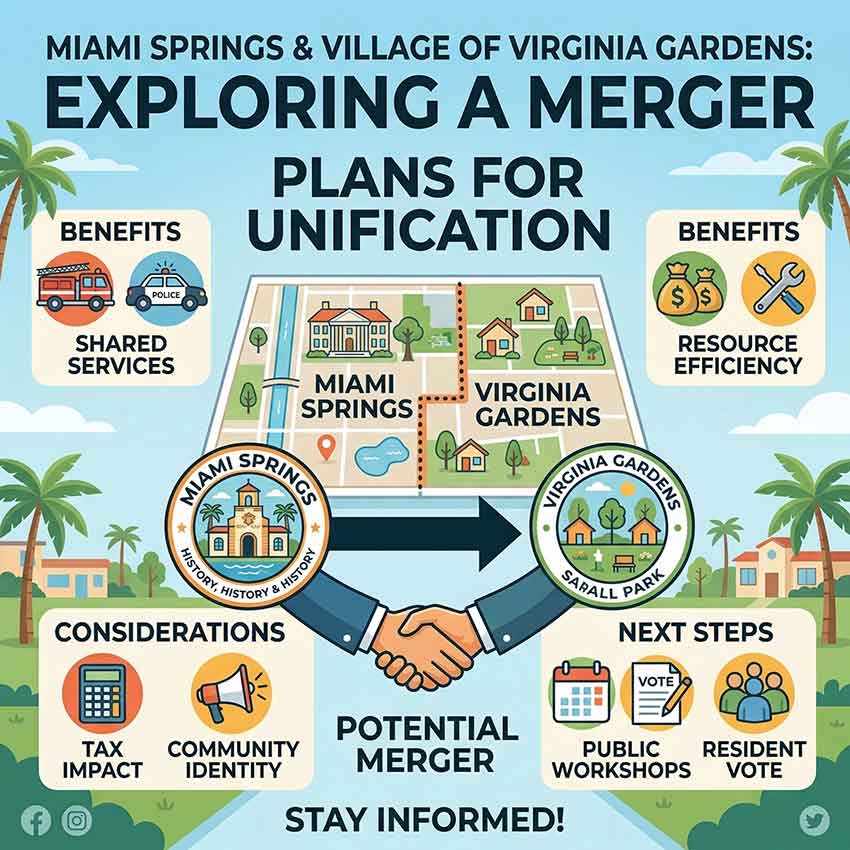
The Dynamics of Municipal Fragmentation and Consolidation: A Case Study of Miami Springs and the Village of Virginia Gardens
The geopolitical and administrative landscape of Miami-Dade County is a complex tapestry of incorporated municipalities, sprawling unincorporated service areas, and constantly evolving jurisdictional boundaries. Within this intricate framework, the historical trajectory and current relationship between the City of Miami Springs and the Village of Virginia Gardens present a deeply compelling case study in municipal governance. What began as a unified, visionary community in the early twentieth century eventually fractured over a highly specific, localized zoning dispute. This fracture led to more than seven decades of parallel existence, characterized by divergent administrative scales but increasingly convergent demographic and socioeconomic profiles. In recent years, both municipalities have engaged in fierce, highly consequential, and politically fraught battles to annex adjacent unincorporated commercial enclaves. These annexation campaigns have yielded drastically different outcomes, fundamentally altering the regional balance of power and exposing the severe vulnerabilities inherent in municipal fragmentation.
This comprehensive research report examines the historical origins of the schism between Miami Springs and Virginia Gardens, exhaustively details their respective campaigns for territorial expansion, and analyzes their current demographic, financial, and administrative capacities. Furthermore, by synthesizing historical data, municipal budget analyses, legislative statutes, and advanced academic theories regarding municipal economies of scale, this analysis formulates a strategic, legally sound blueprint for reunifying the two municipalities. The ultimate objective is to demonstrate how these sister cities can optimize public service delivery, harmonize their tax bases, and secure long-term geopolitical and financial stability through a formal municipal consolidation.
Part I: Historical Context and the Origins of Fragmentation
To understand the current geopolitical friction between the City of Miami Springs and the Village of Virginia Gardens, one must first examine their shared origins and the specific cultural and legislative catalysts that drove them apart.
The Founding of Miami Springs and the Vision of Glenn Curtiss
The City of Miami Springs was originally conceptualized and founded in 1926 as “Country Club Estates” by the legendary aviation pioneer, inventor, and real estate developer Glenn H. Curtiss. Spanning approximately 2.9 square miles in a distinctive triangular shape, the city was meticulously designed to serve as a preferred, serene community for airline employees, executives, and professionals tied to the burgeoning aviation industry that was taking root in South Florida. Conveniently located in the geographic heart of Miami-Dade County, the municipality developed alongside the rapid expansion of the nearby aviation infrastructure, positioning itself as a premier residential enclave.
In its early decades, the community thrived as a unified entity. The area’s expansive tracts of land and relatively low population density attracted not only aviation professionals but also affluent individuals who sought large properties for agricultural and recreational purposes. Equestrian estates and expansive horse farms became a defining feature of the local culture and economy, establishing a distinctly pastoral character within the broader context of a developing metropolitan region.
The 1947 Agricultural Divide and the Secession
For over two decades, the area operated cohesively. However, a severe cultural and zoning schism emerged in the immediate post-war era. In 1947, the municipal government of Miami Springs passed a sweeping ordinance that officially outlawed the keeping of horses within its city limits. This regulatory shift reflected a desire by city leadership to modernize the municipality, shedding its rural agricultural trappings in favor of a more standardized suburban environment.
This ordinance, however, was viewed as an existential threat to a specific, highly influential subset of the population: the operators of large horse farms and the owners of sprawling equestrian estates. In direct response to the anti-equestrian legislation, a coalition of approximately fifty residents decided to formally break away from the jurisdiction of Miami Springs. Many of these dissenting residents were wealthy transplants from the state of Virginia, a demographic detail that ultimately inspired the naming of their newly formed enclave: the Village of Virginia Gardens.
The Village of Virginia Gardens was officially incorporated as an independent municipality on July 10, 1947, during a ceremony where Judge Marshall C. Wiseheart swore in J.E. Hardy as the Village’s first mayor. At the time of its founding, Virginia Gardens was characterized by sprawling properties, with many estates encompassing parcels as large as five acres (approximately 20,000 square meters). These large properties were perfectly suited for barns, horse stables, and rural living, allowing the Village to successfully preserve its identity as an equestrian haven and operate as a micro-municipality deeply intertwined with the rural lifestyle that the leadership of Miami Springs had explicitly rejected.
The Encroachment of Aviation and Suburbanization
The pastoral, equestrian-centric identity of Virginia Gardens, which served as its fundamental raison d’être, was irreparably altered in the 1960s by the insatiable spatial demands of the aviation industry. To accommodate the massive growth of commercial air travel, the Miami-Dade Port Authority utilized eminent domain and other acquisition methods to absorb 450 acres of land from within the boundaries of Virginia Gardens for the expansion of Miami International Airport (MIA).
This massive land acquisition severed the Village’s agricultural roots and radically contracted its geographic footprint. The grand equestrian estates that once characterized the Village were subsequently subdivided and converted into typical, dense suburban residential developments to house an expanding regional workforce. Today, the Village of Virginia Gardens covers a mere 0.3 square miles of land (approximately 0.76 square kilometers). The grand horse farms have entirely vanished; currently, only a single 1-acre residential property remains as a tangible relic of its founding era.
Much like its neighbor Miami Springs, Virginia Gardens became inextricably tied to the airport economy. The Village currently hosts major airport-related facilities, including extensive flight training academies for international aerospace corporations such as Boeing and Pan Am, as well as corporate headquarters for entities like Televisa International. Despite their historical divergence and parallel administrative structures, the two municipalities share contiguous geographic borders, overlapping local economies, and a shared vulnerability to the infrastructural pressures emanating from Miami International Airport. Both communities have fought localized battles against airport expansion. For example, Virginia Gardens notably opposed a two-billion-dollar MIA expansion and an $11.2 million noise barrier project, which residents argued failed to adequately mitigate the severe acoustic impact of a newly constructed fourth runway.
Part II: Demographic Evolution and Socioeconomic Convergence
To evaluate the sociopolitical feasibility of reuniting these two municipalities, one must assess their current demographic and socioeconomic compositions. A detailed analysis of census data over the past two decades reveals that the cultural and economic barriers that justified the 1947 secession—namely, the divide between wealthy Virginian equestrians and working-class aviation personnel—no longer exist. The populations have experienced deep socioeconomic convergence.
Population Dynamics and Growth
The City of Miami Springs operates at a significantly larger scale than its neighbor. As of the 2020 United States Census, Miami Springs is home to 13,859 residents, distributed across 5,245 households and 3,437 families. The city maintains a high housing occupancy rate of 94.4% across its 5,361 housing units. Conversely, the Village of Virginia Gardens is a micro-municipality. The 2020 census recorded a population of just 2,364 people, representing 770 households and 568 families. While Miami Springs represents a robust, medium-density suburban environment, Virginia Gardens has experienced virtually stagnant population growth, largely due to its absolute lack of developable land and its tiny 0.3-square-mile footprint. Historical data shows Virginia Gardens’ population fluctuated slightly from 2,348 in 2000 to 2,375 in 2010, before settling at 2,364 in 2020. Recent estimates project the Village’s population to remain highly stable at approximately 2,362 through 2026.
Racial, Ethnic, and Linguistic Homogeneity
Both municipalities have undergone significant demographic transformations mirroring the broader trends of Miami-Dade County, transitioning into predominantly Hispanic communities. In Miami Springs, the 2020 census identified the Hispanic or Latino population (of any race) as constituting 77.7% of the total population. The Non-Hispanic White population accounts for 19.6%, with other racial groups representing very small minorities (1.8% African American, 1.1% Asian). Furthermore, 66.7% of Miami Springs residents report Spanish as their first language, while 43.6% of the population is foreign-born.
The demographic profile of Virginia Gardens is strikingly identical. As of the 2020 census, individuals identifying as Hispanic or Latino accounted for 84.94% of the Village’s population. Non-Hispanic Whites made up 12.23%, with minimal representation from other racial categories (0.59% African American, 0.63% Asian). Linguistic data from the 2000 census highlighted this trend early, noting that 71.66% of Virginia Gardens residents spoke Spanish as their first language. A subset of the population also includes a notable Pakistani demographic, contributing to Urdu being the second most common non-English language spoken at home in the Village.
Economic Indicators and Age Distribution
Economically, both municipalities function as middle-to-upper-middle-class enclaves. In Miami Springs, the median income for a household is $65,910, and the median income for a family is $75,575. The per capita income stands at $29,401, with an overall poverty rate of 7.5%. The median age in the city is 42.5 years, indicating an established, mature community.
Virginia Gardens displays comparable economic stability. Recent demographic surveys indicate a median household income of $70,469 and a poverty rate of 6.44%. Earlier data from 2015 placed the median property value at $227,800, which has undoubtedly appreciated significantly alongside regional real estate trends. The median age in the Village ranges from 39.2 to 45.2 years depending on the specific survey year, aligning perfectly with the age distribution of Miami Springs.
| Demographic Metric (2020/Recent Estimates) | City of Miami Springs | Village of Virginia Gardens |
| Total Population |
13,859 |
2,364 |
| Hispanic/Latino Population |
77.7% |
84.9% |
| Non-Hispanic White Population |
19.6% |
12.2% |
| Median Household Income |
$65,910 |
$70,469 |
| Poverty Rate |
7.5% |
6.4% |
| Median Age |
42.5 years |
45.2 years |
The statistical evidence is conclusive: the populations of Miami Springs and Virginia Gardens are sociologically, culturally, and economically homogeneous. The integration of these two municipalities would not result in a clash of disparate community values, but rather the formal unification of a single demographic entity that currently operates under redundant administrative systems.
Part III: The Geopolitics of Annexation and the “Donut Hole”
While the demographic realities suggest harmony, the modern political history of both Miami Springs and Virginia Gardens has been dominated by highly aggressive, competitive efforts to annex unincorporated land to their west. This territorial expansion is not merely an exercise in civic pride; it is an economic imperative. Both municipalities seek to dilute their residential tax burdens by absorbing highly lucrative commercial and industrial properties.
The Creation of the UMSA Enclave
The urgency for annexation was catalyzed by the incorporation of the neighboring City of Doral. When Doral officially incorporated, it carved out its municipal boundaries in a highly selective manner. It left behind a massive, highly developed, unincorporated commercial and industrial zone stranded between Doral to the west, and Miami Springs, Virginia Gardens, and the Town of Medley to the east.
This geographical anomaly created what urban planners and county officials refer to as an “enclave” or a “donut hole”—an isolated, disjointed pocket of the Unincorporated Municipal Service Area (UMSA). Miami-Dade County maintains a strict, stated policy of eliminating such enclaves, as they severely complicate county-level service delivery, disrupt contiguous municipal boundaries, and create inefficiencies in emergency response. Recognizing that the absorption of this area by surrounding municipalities was an inevitable policy objective of the county, a four-city agreement was historically brokered between Doral, Medley, Virginia Gardens, and Miami Springs. The intent of this agreement was to equitably divide and annex the remaining UMSA territory without sparking a protracted border war.
The Commercial Allure of the Logistics Hub
The targeted annexation area is devoid of residential neighborhoods; it is an economic powerhouse. Situated adjacent to Miami International Airport and bounded by major arterial corridors such as State Road 826 and State Road 836, the zone is a global logistics hub. The area encompasses over 1,815 active businesses, warehouses, freight forwarders, and industrial complexes. Billions of dollars in international cargo and merchandise pass through this hub annually.
For a residential “bedroom community” like Miami Springs, or a micro-village like Virginia Gardens, acquiring jurisdiction over this commercial tax base is universally viewed as a “once in a lifetime opportunity” to secure long-term financial solvency. Because the cost of providing municipal services (such as schools, parks, and libraries) to commercial properties is vastly lower than providing services to residential areas, the annexation of industrial zones generates massive net tax surpluses. These surpluses can be utilized to fund ambitious civic capital projects, aggressively pay down existing municipal debt, and significantly lower the ad valorem property tax (millage rate) for existing homeowners.
Part IV: The Collapse of the Miami Springs Annexation Campaign
Recognizing the transformative economic potential of the logistics hub, the City of Miami Springs engaged in a relentless, two-decade-long campaign to annex its designated portion of the western enclave. The effort consumed tens of thousands of dollars in administrative man-hours, lobbying fees, consultant reports, and legal counsel. Despite years of meticulous planning and initial optimism, the campaign ended in a crushing, highly publicized legislative defeat that has permanently altered the city’s financial trajectory.
Two Decades of Legislative Effort
Miami Springs initiated its formal annexation efforts in 2002. Over the subsequent years, the city’s administration conducted numerous informational campaigns to secure resident approval and build consensus. This sustained effort culminated in a special municipal election on April 7, 2009, where the voters of Miami Springs overwhelmingly approved the annexation initiative by a massive margin of 76% to 24%.
The financial projections developed by the city’s finance department painted a highly lucrative picture. The total assessed value of the target annexation area was estimated at approximately $977 million. The city calculated that the annexed commercial properties would generate $7.2 million in new gross annual revenues. After accounting for $2.5 million in newly required municipal expenses—such as the hiring of new police personnel, the purchase of specialized public works equipment, and roadway maintenance—the city projected a net annual surplus of $4.7 million. The City Council publicly pledged to use this massive surplus to lower the city’s overall residential millage rate from 7.3500 to an estimated 4.9400, thereby providing massive, generational tax relief to homeowners without altering the fundamental residential character of the city.
Despite overwhelming resident approval and sound financial modeling, the process stalled repeatedly at the county legislative level. In 2013, the applications of all four participating cities failed to pass the Miami-Dade Land and Use Committee and the broader Board of County Commissioners (BCC). Following subsequent requests from the county to resubmit updated proposals, the Miami Springs City Council passed the annexation application again with a unanimous 5-0 vote on June 26, 2017. To preempt a looming legal challenge, the city held yet another resident vote on November 6, 2018, aggressively reaffirming public support for the expansion.
The Final Defeat in 2022
The culmination of the 20-year endeavor arrived on November 1, 2022. The Miami-Dade Board of County Commissioners convened to hear and vote on the respective, overlapping applications of Miami Springs, Virginia Gardens, and the Town of Medley.
In a shocking divergence of political outcomes, the BCC approved the Town of Medley’s application by a decisive vote of 8 to 3, and subsequently denied the applications by Miami Springs and the Village of Virginia Gardens.
Autopsy of the Failure
The rejection of the Miami Springs applicatio can be attributed to several fatal tactical missteps and systemic economic disadvantages:
-
Hostile Commercial Opposition: The most vocal and influential constituency at the BCC hearing was not the residents of Miami Springs, but rather the business owners located within the proposed annexation zone. These commercial property owners vehemently opposed being absorbed into Miami Springs, primarily due to taxation concerns. Their opposition was highly organized. A county-mandated survey of 843 real estate property folios in the proposed area, conducted by the County’s Office of Management and Budget, returned 285 valid responses; of those, an overwhelming 283 explicitly opposed the annexation, with only one in favor and one unmarked.
-
Uncompetitive Tax Rates: Miami Springs suffered from having the highest existing millage rate among the competing municipalities. Even with the promised post-annexation reduction to 4.9400 mills, the immediate tax burden on the annexed businesses would represent a massive 281% increase in the municipal portion of their property taxes compared to their prior unincorporated UMSA status. By contrast, Medley offered significantly lower starting millage rates, making their annexation bid vastly more palatable to both the affected property owners and the voting County Commissioners.
-
Failures in Strategic Advocacy: Local critics and political observers noted a severe lack of communication and strategic advocacy by Miami Springs leadership at the critical BCC meeting. While Mayor Maria Mitchell provided brief testimony, there was no robust, data-driven presentation by the City Manager or the City Attorney to aggressively counter the anti-annexation speakers. The city fundamentally failed to remind the BCC that its application was a direct effort to solve the “donut hole” problem created by the county’s own incorporation of Doral twenty years prior.
The failure permanently deprived Miami Springs of a major commercial tax base, ensuring that residents would not see the projected millage rate reductions and leaving the city to manage its existing infrastructural debts without the infusion of a new, dynamic revenue stream.
Part V: Current Administrative Realities and Existing Cooperation
To evaluate the operational feasibility of a municipal merger, an examination of current municipal finances and existing interlocal agreements is required. The data reveals that while their budgets differ vastly in scale, the two municipalities are already deeply intertwined in their daily operations.
Disparate Municipal Finances and Taxation
The financial apparatus of the two cities starkly reflects their difference in size and scale.
-
Miami Springs: Operates a substantial General Fund budget of approximately $23.6 million for FY 2024-2025. The city’s administration recently proposed maintaining its operating millage rate at a relatively high 6.9100 to balance the budget without the anticipated annexation revenues. Of the general fund, approximately $13.9 million (59.9%) is dedicated strictly to employee salaries and benefits. While Miami Springs bears a higher tax rate, its robust budget supports a comprehensive suite of civic amenities, including an 18-hole golf course, a municipal aquatic center, a community theater, and a sophisticated public works department.
-
Virginia Gardens: Operates a micro-budget. The General Fund budget is projected at approximately $3.36 million to $3.47 million for the FY 2024-2026 cycles. To address recent structural deficits and prepare for operational expansion, the Village was forced to increase its operating millage rate from 4.6000 to 4.8500 for the fiscal year ending September 30, 2024.
Both municipalities benefit from federal and state grants to augment their operations. For instance, Congressman Mario Díaz-Balart recently secured nearly $1 million in federal funding for local law enforcement, allocating $450,000 to the Virginia Gardens Police Department for vital technology and communications upgrades, and $500,000 to the Miami Springs Police Department to upgrade six marked Sport Utility Vehicles. While these grants provide temporary relief, they do not solve long-term structural deficits.
Existing Inter-Municipal Cooperation
Crucially, the groundwork for full municipal consolidation has already been laid through decades of extensive interlocal cooperation. The two municipalities do not operate in isolated silos; they function as a highly integrated regional unit:
-
Public Transit Integration: Miami Springs and Virginia Gardens share a free municipal transit circulator (the “Freebee” shuttle). Recognizing that it lacked the scale to efficiently operate its own transit system, Virginia Gardens entered into a formal interlocal agreement in 2007 (which was subsequently renewed) to remit its entire 20% share of the county’s Charter County Transportation System Surtax proceeds to the City of Miami Springs. In exchange, Miami Springs expanded the route of its City Circulator into the Village.
-
Shared Parks and Recreation Infrastructure: The Miami Springs Parks and Recreation Department treats Virginia Gardens residents as functional equivalents to its own citizens. For example, the Miami Springs Golf & Country Club—a 6,755-yard, par-71 facility established in 1923—offers highly discounted green fees specifically designated for “MS/VG Residents” (e.g., $55 on weekdays compared to the $85 outside public rate). This identical residency status applies to the municipal aquatic center, where cabana rentals, pool access, and multi-purpose room rentals are offered at unified “MS/VG Resident” tiers, distinctly separating them from higher “Non-Resident” pricing.
-
Unified Fire and Emergency Medical Services: Neither Miami Springs nor Virginia Gardens maintains an independent municipal fire department. Both rely entirely on the Miami-Dade Fire Rescue Department (MDFR) for fire protection, hazardous materials response, and advanced life support (ALS) emergency medical services. The MDFR is a massive regional entity operating 76 stations across 14 battalions. This reliance on a unified county provider ensures that a municipal merger would have absolutely no disruptive impact on local fire and rescue operations. Recent tragic events, such as a fatal June 2024 multi-agency firefighting training exercise involving a tar pot fire at a three-story building in Virginia Gardens, underscore the intense, highly specialized nature of modern emergency response. The operational complexity demonstrated by such incidents further highlights why micro-municipalities cannot sustain independent heavy-rescue services and rely on broader regional integrations.
Part VI: The Theoretical and Economic Case for Consolidation
The academic literature surrounding municipal consolidation, public choice theory, and urban economics provides a highly robust theoretical framework for evaluating the potential merger of Miami Springs and Virginia Gardens.
Economies of Scale and Administrative Efficiency
The primary rationale advanced by proponents of municipal mergers is the realization of “economies of scale”. Economic theory dictates that larger local governments can significantly reduce the long-term average costs of public goods production by spreading fixed administrative overhead across a larger, unified population base. In the specific case of Virginia Gardens, maintaining the salaries of a Mayor ($15,968), a Village Council ($33,269), a Village Clerk ($42,471 base allocation), and separate administrative, IT, and financial infrastructures for a population of merely 2,300 residents creates intense, systemic per-capita inefficiencies. A formal municipal merger would immediately eliminate this duplicative executive and administrative overhead.
The academic consensus notes that capital-intensive municipal services—such as urban infrastructure maintenance, road paving, and the procurement of specialized police fleet equipment—exhibit the highest potential for economies of scale. By combining their ad valorem tax bases, a unified city could seamlessly invest in superior public works equipment and advanced law enforcement technology that neither municipality could easily justify or afford independently.
Mitigating Diseconomies of Scale
However, urban economists and political scientists explicitly caution against “diseconomies of scale.” This phenomenon occurs when merged jurisdictions become too massive, leading to a profound loss of democratic participation, civic identity, and responsiveness to localized needs. In vast metropolitan consolidations, the physical and political distance between the voter and the politician expands detrimentally.
Fortunately, the proposed merger of Miami Springs and Virginia Gardens is entirely immune to this critique. A unified municipality would still possess a combined population of approximately 16,000 residents distributed across a highly manageable 3.2 square miles. This scale remains firmly within the optimal parameters of a highly responsive, localized “small town” government, completely avoiding the bureaucratic congestion and civic alienation that plagues major county-level consolidations.
Public Choice Theory and Economic Development
Public choice theory adds nuance to the merger debate, noting that while consolidations may drastically reduce redundant administrative expenditures, they do not inherently guarantee a reduction in total local government spending. Rather, mergers expand the size of the common tax pool, allowing the unified government to reallocate funds toward higher-quality public services and ambitious regional development projects that were previously unattainable due to fragmentation.
Furthermore, empirical studies utilizing the Synthetic Control Method (SCM) to evaluate city-county consolidations have demonstrated that while mergers are not a panacea for all economic woes, they drastically improve the comprehensive planning capacity of local governments. By merging, Miami Springs and Virginia Gardens would eliminate socially inefficient, zero-sum competition for commercial annexations. A unified planning and zoning department would allow for the seamless integration of the newly annexed $1.19 billion logistics hub into the broader municipal framework, presenting a unified, powerful front when negotiating with Miami-Dade County officials and international corporate stakeholders.
Part VIII: Legal Precedents and the Statutory Path to Merger
Any effort to reunify the two cities must adhere strictly to the rigorous legal procedures mandated by Florida State Law and the specific provisions of the Miami-Dade County Home Rule Charter.
Florida Statutes Chapter 165
Chapter 165 of the Florida Statutes, known formally as the “Formation of Local Governments Act,” provides the exclusive general law procedures for the formation, dissolution, and merger of municipalities in the state. Section 165.031 explicitly defines a “merger” as the combining of two or more municipalities with each other. Typically, the dissolution or merger of a municipality requires an ordinance passed by the governing bodies, followed by an affirmative vote of the qualified electors residing within the affected jurisdictions.
The Miami-Dade County Home Rule Charter
Crucially, Florida Statute 165 contains a preemption clause that defers to counties operating under a specialized home rule charter, provided that charter outlines an exclusive method for municipal boundary adjustments. Miami-Dade County possesses exceptionally broad home rule powers. Article 6 and Section 1.01 of the Miami-Dade Charter explicitly grant the Board of County Commissioners (BCC) the sweeping authority to “change the boundaries of, merge, consolidate, and abolish… municipal corporations” whose jurisdictions lie wholly within the county.
However, this power is not absolute. Section 6.02 of the County Charter, titled “Continuance of Municipalities,” serves as a vital democratic safeguard. It guarantees that “the municipalities in the county shall remain in existence so long as their electors desire,” explicitly stating that no municipality shall be abolished without the approval of a majority of its electors voting in an election called for that specific purpose.
The Islandia Precedent vs. The Democratic Mandate
The legal mechanics of municipal abolition in Miami-Dade County were tested during the highly publicized dissolution of the City of Islandia. Incorporated in 1961 by a mere 13 voters, Islandia encompassed 33 islands in Biscayne Bay and was envisioned as a bustling luxury resort community connected by causeways. The development failed utterly; the federal government purchased the land to create Biscayne National Park, and by 1990, the state ruled Islandia’s elections illegal because voters did not actually reside on the islands.
In 2012, Miami-Dade County formally abolished Islandia, reverting the territory to unincorporated status. However, this abolition was achieved via a highly specific charter amendment that allowed the BCC to bypass a resident vote solely because Islandia had twenty or fewer registered electors at the time of the ordinance.
Because both Miami Springs and Virginia Gardens possess thousands of active, registered electors, the Islandia loophole is entirely inapplicable. Any merger between the two cities must be fundamentally democratic and resident-driven. Under Section 6.03 of the County Charter, a merger or charter revocation can be initiated through two primary mechanisms:
-
Governing Body Resolution: The City Council of Miami Springs and the Village Council of Virginia Gardens can pass mutual resolutions instructing their legal teams to draft a consolidated municipal charter.
-
Citizen Initiatory Petition: Alternatively, the electors of the municipalities can bypass reluctant politicians by gathering a formal petition signed by ten percent (10%) of the qualified electors in each respective municipality.
Within 120 days of the resolution passage or petition certification, the drafted merger proposal must be submitted to the electors at a special election. If a majority of voters in both jurisdictions approve the measure, the new unified municipal charter becomes effective.
Part IX: A Strategic Blueprint for Municipal Reunification
Given the devastating failure of Miami Springs to secure its commercial annexation, and the severe, potentially catastrophic operational risks Virginia Gardens faces in attempting to independently police and govern a global logistics hub, a formal reunification of the two cities represents the most strategically sound, economically viable path forward.
By executing a merger, Miami Springs instantly gains jurisdiction over the lucrative $1.19 billion commercial tax base that Virginia Gardens has legally secured. Conversely, Virginia Gardens gains immediate access to the robust police force, extensive capital reserves, and sophisticated administrative machinery of Miami Springs that are absolutely necessary to govern that massive territorial expansion safely.
The following is a phased, highly actionable legislative and administrative blueprint for executing this municipal merger.
Phase 1: Establishment of a Joint Consolidation Commission
The complex process of reunification must begin with the formal establishment of an exploratory Joint Consolidation Commission. This body should be composed of elected officials, municipal finance directors, city attorneys, and key citizen representatives from both municipalities. This commission will be tasked with conducting a comprehensive, transparent feasibility study, focusing on:
-
Asset and Liability Reconciliation: The commission must execute a rigorous audit of the outstanding bonded debts, pension obligations, and capital assets of both cities. An equitable legal arrangement must be structured to ensure that the taxpayers of one municipality do not unfairly absorb the historical legacy debts of the other.
-
Zoning and Code Harmonization: Reconciling the municipal codes is critical. Because Virginia Gardens is almost entirely residential with only a minor commercial strip along NW 36th Street , its existing zoning regulations are highly compatible with the strict “bedroom community” nature of Miami Springs.
-
Tax Base Modeling and Millage Unification: The finance directors must model the unified millage rate. By blending Miami Springs’ current 6.9100 rate with Virginia Gardens’ 4.8500 rate, and subsequently injecting the massive new ad valorem revenues generated from the $1.19 billion commercial annexation, financial models indicate the unified city could likely offer a stabilized millage rate in the low 5.0000s. This would provide immediate, permanent tax relief to Miami Springs residents while securing world-class, heavily funded municipal services for Virginia Gardens residents.
Phase 2: Consolidation of Public Safety and Administration
The most urgent operational necessity driving the merger is the integration of the police departments. The Virginia Gardens Police Department, operating on a budget of roughly $1.78 million with a skeletal staff, is quantitatively insufficient to patrol a high-threat global logistics hub independently.
-
Law Enforcement Integration: The personnel and assets of the Virginia Gardens Police Department should be systematically absorbed into the Miami Springs Police Department command structure. Miami Springs currently boasts 47 sworn officers, 19 civilian employees, and a dedicated command staff including a Chief, Deputy Chief, and four Lieutenants. This integration instantly scales the combined force to nearly 70 sworn officers. It provides the necessary manpower, specialized units (including existing K-9 teams and motorcycle units), and advanced dispatch capabilities required to secure both the quiet residential zones and the volatile, newly annexed commercial hub.
-
Administrative Streamlining: The duplicative administrative functions of Virginia Gardens (including the Village Clerk, finance department, IT services, and public works) would be dissolved and efficiently absorbed into the larger infrastructure of Miami Springs City Hall. To ensure a continued local presence and preserve civic identity, the physical Virginia Gardens municipal building could be repurposed as a unified community policing substation or a localized public works dispatch depot.
Phase 3: Drafting the Unified Charter and Electoral Referendum
The final phase requires the Joint Commission to draft a new, unified municipal charter. To respect the profound historical identity of both communities, the unified entity could be rebranded (e.g., “The City of Miami Springs and Virginia Gardens” or potentially return to the original, historically significant “Country Club Estates” moniker).
-
Electoral Districts: To ensure absolutely fair representation and prevent the smaller population of Virginia Gardens from feeling politically eclipsed by the much larger Miami Springs voting bloc, the new City Council must be structured using single-member geographic districts rather than at-large voting. One or two council seats must be geographically drawn to encompass the historical boundaries of Virginia Gardens, guaranteeing them perpetual, proportional representation on the unified legislative council.
-
The Democratic Vote: Once the charter is finalized, it must be placed on the ballot during a high-turnout general election cycle. The public advocacy campaign must clearly, repetitively articulate the overwhelming financial and operational benefits: permanent lower property taxes for Miami Springs, and sustainable, professionalized public safety and infrastructure for Virginia Gardens.
Conclusion
The 1947 secession of the Village of Virginia Gardens from the City of Miami Springs was an acute product of its time—a hyper-localized legislative dispute over equestrian zoning that unnecessarily fractured a visionary, unified community. Today, over seven decades later, the horses are entirely gone, the expansive rural estates have been systematically replaced by suburban density, and the original cultural rationale for the administrative division has entirely evaporated.
What remains are two adjacent, demographically identical, Hispanic-majority municipalities fighting zero-sum political battles over commercial annexations in western Miami-Dade County. Miami Springs has tragically failed to secure the commercial tax base it desperately requires to lower its high residential millage rates and fund its robust civic amenities.
By aggressively pursuing a legally structured, democratically mandated municipal merger under the exclusive provisions of the Miami-Dade County Home Rule Charter, these two entities can permanently resolve their respective structural vulnerabilities. A reunified municipality would possess the sophisticated administrative machinery and police force of Miami Springs, perfectly married to the massive commercial revenue streams of the Virginia Gardens. This synergy would allow for unparalleled civic investment, permanently lowered property taxes across the board, and a restoration of regional geopolitical relevance. The reunification of Miami Springs and Virginia Gardens is not merely an exercise in historical romance or academic theory; it is a vital, urgent strategic necessity for the long-term economic prosperity and public safety of both communities.
FINAL THOUGHTS!
If you read this entire report, we want to thank you. We also want to point out that this publication is dated, April 1st, 2026. As such, it should receive the appropriate skepticism.
Nevertheless, we want to know what you think?
Should Miami Springs and Virginia Gardens merge back into one municipality? Let us know your thoughts in the comments section below or via social media.